
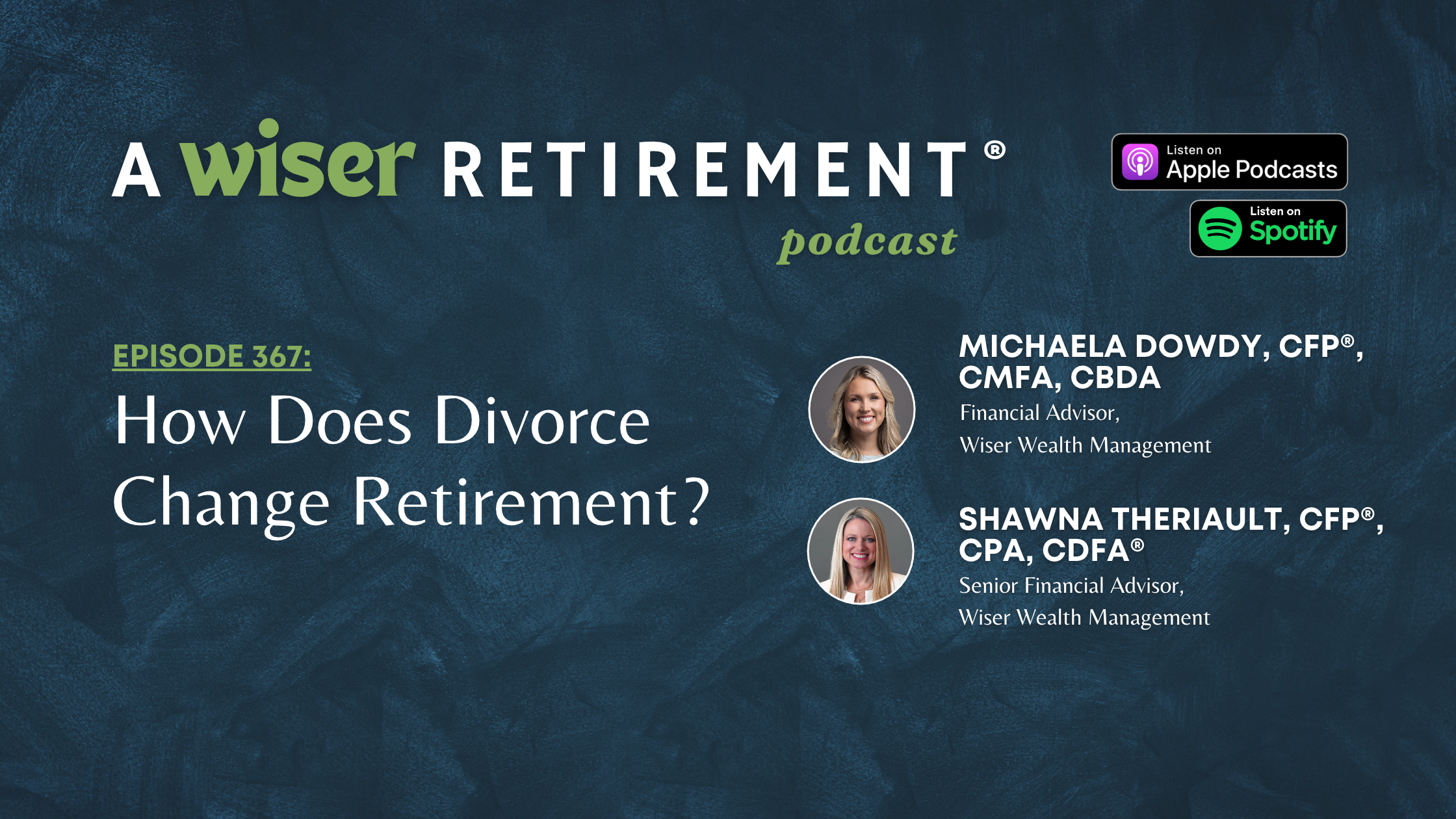
How Does Divorce Change Your Retirement?
In this episode of A Wiser Retirement® Podcast, we discuss how divorce changes retirement planning. Host Michaela Dowdy, CFP®, CMFA, CBDA, joins Senior Financial Advisor Shawna Theriault, CFP®, CPA, CDFA®, to examine the decisions behind dividing retirement accounts, evaluating housing, revisiting taxes, and building an individual financial plan.
Watch or Listen
Summary
One Household Becomes Two Retirement Plans
Divorce does not automatically mean delaying retirement. It does mean revisiting the income, expenses, and assets behind the original plan.
Housing expenses now belong to two households. Spousal support may affect cash flow, and children may still depend on financial help. Separate projections help each person evaluate whether retirement remains feasible and what adjustments may be necessary.
For someone already retired, the questions are similar, but the flexibility may differ. Without additional employment income or savings contributions, spending needs and existing income sources become especially important.
Equal Account Balances Can Have Different Values
A Roth account and a traditional retirement account with the same balance may provide different amounts to spend after taxes. A brokerage account brings another set of tax considerations. Comparing balances alone can overlook those differences.
Access matters, too. Someone who needs cash for housing or immediate expenses needs to understand how accessible the assets they receive actually are.
The paperwork also requires follow-through. A divorce decree identifies the division, but it does not complete every transfer. Certain employer retirement plans use a QDRO, while IRA accounts involve different transfer procedures. Completing the appropriate process matters alongside negotiating the settlement.
Keeping the House Requires Income to Maintain It
Shawna describes a situation in which one spouse keeps the house while the other keeps a pension of roughly comparable value. The balance sheet may appear reasonable, yet the person keeping the home still needs income for maintenance, taxes, insurance, and repairs.
That is the risk of becoming “house poor”: owning the home without enough available resources to support it.
Buying out a spouse may require cash, other assets, or refinancing. Asking the lender whether the existing mortgage is assumable is another consideration, particularly when keeping its terms matters. Approval and affordability still need evaluation. Selling may be an option when keeping the property does not fit the individual plan.
Adult Children and Health Coverage Still Affect Spending
Shawna’s question about children is especially practical: Are they “off the payroll”?
Being over 18 does not necessarily mean financial independence. College, food, gas, car insurance, and health coverage may remain part of a parent’s spending. Those commitments need a place in the retirement projection.
Health insurance also deserves separate attention when one spouse relies on the other’s coverage. Someone planning to retire before Medicare age needs to evaluate how coverage fits into the new household budget.
Social Security Assumptions Need Another Look
Potential benefits based on a former spouse’s Social Security record belong in the retirement review. Marriage duration and remarriage can affect eligibility, so assumptions deserve individual attention.
Michaela offers an example involving a marriage lasting nine years and eight months, illustrating why the timing deserves consideration. The discussion reinforces the importance of examining potential benefits before relying on them as retirement income.
A New Tax Picture Can Change Available Income
Tax planning belongs in the settlement discussion. Filing status, withholding, deductions, retirement distributions, and investment income can all affect what remains available to spend.
A divorce finalized late in the year may leave someone’s withholding out of step with their filing situation. Moving out of the marital home may also change deductions, particularly when someone rents while deciding where to live.
Tax projections help evaluate those changes. They also help someone who does not usually handle household finances understand the potential taxes associated with withdrawals, dividends, interest, and investment sales.
The Same Investment Percentages May Serve Different Needs
Shawna uses an allocation of 80% stocks and 20% bonds to illustrate another issue: Keeping the percentages unchanged after dividing a portfolio leaves a smaller dollar amount in bonds.
The relevant question becomes how much money the individual needs and when. The episode describes a bucket approach that separates near-term spending from longer-term investments.
A large cash settlement may create a different need: deciding how to invest available money. Either situation calls for reviewing liquidity, individual risk preferences, and the tax consequences of changes.
Legal Costs and Estate Documents Deserve Attention
Michaela describes the dilemma of spending $40,000 in legal fees fighting over a $20,000 account. The emotional stakes are real, but the cost of a disagreement also affects retirement resources.
Shawna shares an attorney’s perspective on reaching an agreement: Consider what both people can live with, even when neither feels entirely satisfied.
After the division, beneficiaries, powers of attorney, and executor choices also need review. These decisions address who receives assets and who can help with financial or health care matters.
For someone considering divorce, Shawna recommends consulting an attorney about the specific situation and involving a financial advisor before the settlement is final. Understanding what you own, what you spend, and where income comes from provides the foundation for evaluating retirement on your own. If you would like to meet with one of our financial advisors, please reach out to schedule a complimentary consultation today.
- Schedule a Complimentary Consultation: Discover how our services can help you achieve financial confidence.
- Access Our Free Guides: Gain valuable insights on topics such as why most financial plans fail, how to leave a financial legacy, post-divorce financial planning, and more!
- Subscribe to A Wiser Retirement® YouTube Channel.
- Listen to A Wiser Retirement® Podcast and access previous episodes.
Connect:

Recent posts



Share This Story, Choose Your Platform!
Wiser Wealth Management, Inc (“Wiser Wealth”) is a registered investment adviser with the U.S. Securities and Exchange Commission (SEC). As a registered investment adviser, Wiser Wealth and its employees are subject to various rules, filings, and requirements. You can visit the SEC’s website here to obtain further information on our firm or investment adviser’s registration.
Wiser Wealth’s website provides general information regarding our business along with access to additional investment related information, various financial calculators, and external / third party links. Material presented on this website is believed to be from reliable sources and is meant for informational purposes only. Wiser Wealth does not endorse or accept responsibility for the content of any third-party website and is not affiliated with any third-party website or social media page. Wiser Wealth does not expressly or implicitly adopt or endorse any of the expressions, opinions or content posted by third party websites or on social media pages. While Wiser Wealth uses reasonable efforts to obtain information from sources it believes to be reliable, we make no representation that the information or opinions contained in our publications are accurate, reliable, or complete.
To the extent that you utilize any financial calculators or links in our website, you acknowledge and understand that the information provided to you should not be construed as personal investment advice from Wiser Wealth or any of its investment professionals. Advice provided by Wiser Wealth is given only within the context of our contractual agreement with the client. Wiser Wealth does not offer legal, accounting or tax advice. Consult your own attorney, accountant, and other professionals for these services.