
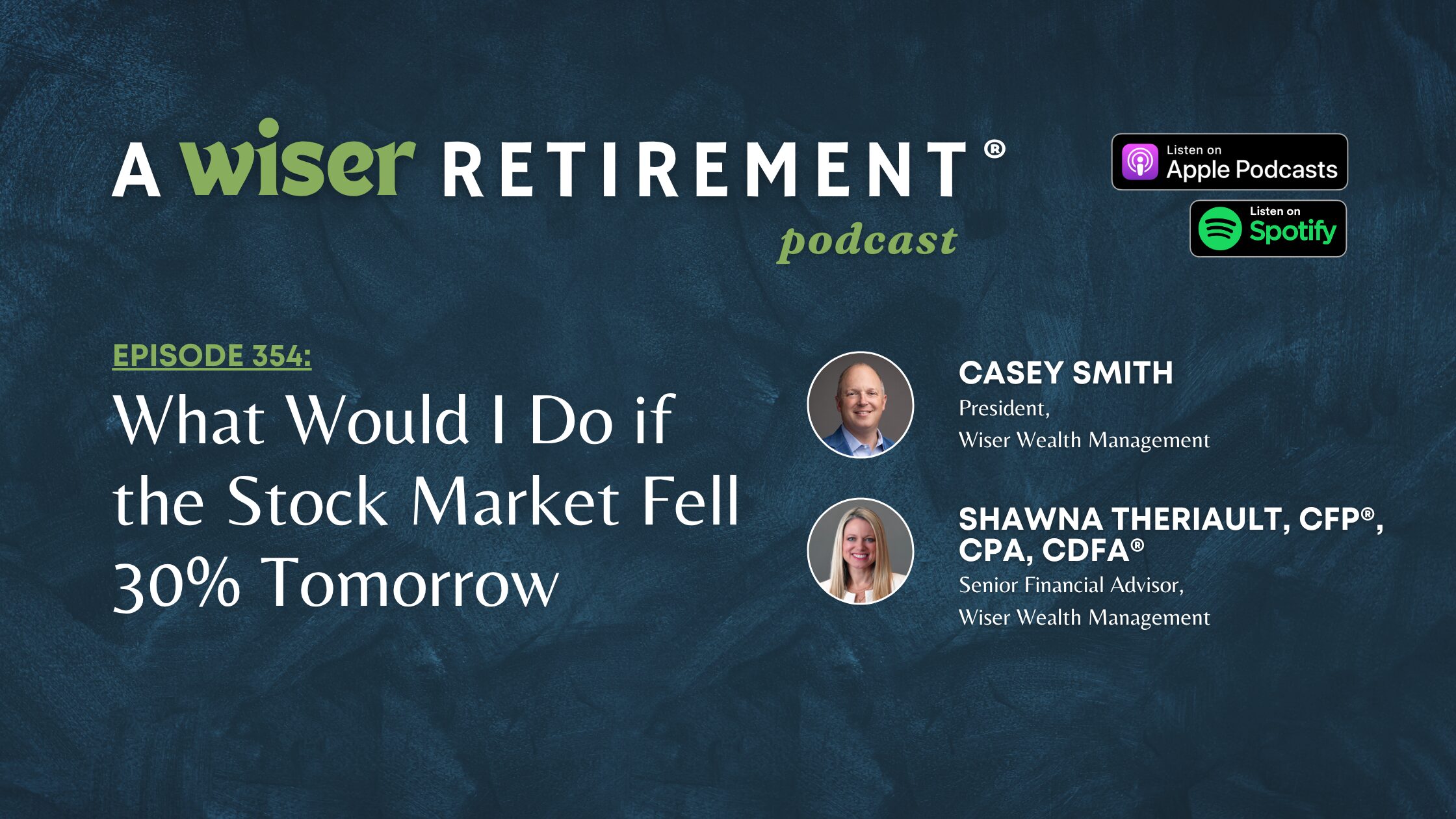
What Would I Do if the Stock Market Fell 30% Tomorrow
A 30% stock market decline gets attention quickly. Account balances fall, headlines become more alarming, and investors may feel pressure to make an immediate change. But a market downturn does not automatically mean your long-term financial strategy needs to change. In many cases, the more important question is whether anything about your personal financial situation has changed.
In this episode of A Wiser Retirement® Podcast, we discuss how instead of reacting to the market itself, investors can focus on the elements they can control: liquidity, diversification, portfolio allocation, taxes, contributions, and their long-term financial plan.
Listen or Watch
Summary
Start With the Financial Plan, Not the Headlines
When markets decline sharply, financial news can make every movement feel urgent. That does not necessarily mean action is required.
A better starting point is your financial plan.
Ask whether your financial circumstances actually change. Do you still have employment income? Are your bills manageable? Does your retirement timeline remain the same? Have your spending needs changed? Do you need money from the portfolio sooner than originally planned?
If those answers remain largely unchanged, a market decline alone may not justify abandoning a long-term investment strategy.
Market volatility can also reveal how an investor genuinely responds to risk. It is easy to feel comfortable with an aggressive portfolio when markets are rising. A downturn provides a much clearer picture of how much volatility someone can emotionally and financially tolerate.
Prepare for Market Declines Before They Happen
The strongest response to a major market decline often begins well before the decline occurs.
Working investors generally need adequate emergency reserves so an unexpected expense or job loss does not force them to sell investments during a difficult market.
Retirees may need a more structured liquidity strategy. At Wiser Wealth Management, this can include a cash bucket for near-term withdrawals, fixed income for intermediate needs, and stocks positioned for longer-term growth.
The objective is to separate money needed for everyday living from assets intended for long-term investment.
Debt also matters. Keeping debt obligations manageable and maintaining appropriate cash reserves can provide more flexibility if a market downturn occurs at the same time as a job loss or another financial disruption.
Avoid Turning a Market Decline Into a Permanent Loss
One of the most damaging decisions an investor can make is selling because the emotional discomfort of a declining market becomes too great.
Selling presents a second problem: deciding when to reinvest.
An investor who moves to cash has to make two difficult decisions correctly, when to get out and when to get back in. A market recovery may begin before the economic environment feels comfortable again, which means waiting for greater “certainty” can result in missing part of the rebound.
Instead of attempting to predict the market’s bottom or recovery, investors can return to the strategy established when conditions are calmer.
The goal is to avoid making a permanent financial decision based on a temporary emotional response.
Use Rebalancing to Maintain Your Target Allocation
A significant market decline can move a portfolio away from its intended allocation.
For example, imagine an investor begins with a portfolio containing 60% stocks and 40% bonds. After a large stock market decline, stocks may represent a much smaller percentage of the overall portfolio.
Rebalancing does not necessarily mean becoming more conservative because the market falls. It means adjusting the portfolio toward its intended allocation.
That can involve selling part of an asset class that now represents too much of the portfolio and purchasing an asset class that has become underweight.
The same principle works when markets rise substantially. Rebalancing can trim an overweight position and redirect those proceeds toward another part of the portfolio.
The appropriate approach depends on the investor’s liquidity needs, time horizon, tax situation, and overall financial plan.
Look for Tax-Loss Harvesting Opportunities
Market declines can also create tax-planning opportunities in taxable brokerage accounts.
Tax-loss harvesting involves selling an investment that has declined and realizing the loss for tax purposes while maintaining an appropriate investment strategy.
Realized capital losses can generally offset realized capital gains. When losses exceed gains, up to $3,000 may generally be used against ordinary income under current federal tax rules, with remaining eligible losses carried forward to future tax years.
The objective is not simply to generate a loss. It is to manage the investment portfolio and tax strategy together.
Investors also need to consider rules such as the wash-sale rule when replacing investments, which is one reason tax-loss harvesting should be coordinated carefully.
Evaluate Roth Conversion Opportunities
A lower market may also create an opportunity to evaluate a Roth conversion.
When investments inside a traditional IRA decline in value, converting some of those assets to a Roth IRA may result in less taxable income than converting the same assets at a higher valuation.
If those assets later appreciate inside the Roth IRA, future qualified distributions may be tax-free.
That does not make a Roth conversion appropriate for everyone. Current income, tax brackets, Medicare considerations, future tax expectations, available cash to pay the tax, and the overall retirement plan all matter.
A market decline simply creates another point at which the strategy may be worth evaluating.
Continue Investing When It Fits the Plan
A declining market often makes investors want to stop contributing to retirement accounts until conditions feel safer.
That reaction can work against a long-term strategy.
Someone who continues making 401(k) or other investment contributions is purchasing investments at multiple prices over time. If an employer match is available, stopping contributions may also mean giving up part of an employee benefit.
For investors with sufficient emergency reserves and available cash flow, a downturn may even be a time to evaluate whether additional long-term contributions make sense.
The decision should come from the financial plan rather than fear about what the market may do next.
Maintain the Cash You Need
Continuing to invest does not mean putting every available dollar into the market.
Cash reserves remain important during periods of uncertainty.
If markets decline significantly, it can make sense to become especially careful about unnecessary withdrawals from emergency savings. Those reserves provide flexibility if income changes, an unexpected expense occurs, or a retiree needs to fund spending without selling stocks after a major decline.
A well-constructed portfolio gives different dollars different jobs.
Cash handles near-term needs. High-quality fixed income can address intermediate needs. Stocks can remain focused on longer-term growth and helping offset inflation over time.
Market Volatility Is Part of Long-Term Investing
Major market declines feel different every time because the events surrounding them are different. Investors experience recessions, financial crises, geopolitical uncertainty, public health emergencies, changing interest rates, and other periods of instability.
The circumstances change, but the emotional temptation is often similar: do something immediately.
That is why preparation matters.
A diversified portfolio, appropriate liquidity, manageable debt, coordinated tax planning, and a financial plan can provide a framework for making decisions when markets become volatile.
The question during a 30% decline is not simply, “What is the market doing?”
It is, “Has anything changed that requires us to change the plan?”
For many investors, staying disciplined does not mean literally doing nothing. Behind the scenes, there may be rebalancing opportunities, tax-loss harvesting, Roth conversion analysis, liquidity reviews, and financial-plan updates.
Sometimes the appropriate investment decision is to stay with the existing allocation. The important part is making that decision intentionally rather than reacting to fear. If you don’t have a financial plan in place, please reach out to us to start the conversation with a complimentary consultation today.
- Schedule a Complimentary Consultation: Discover how our services can help you achieve financial confidence.
- Access Our Free Guides: Gain valuable insights on topics such as why most financial plans fail, how to leave a financial legacy, post-divorce financial planning, and more!
- Subscribe to A Wiser Retirement® YouTube Channel.
- Listen to A Wiser Retirement® Podcast and access previous episodes.
Connect:

Recent posts



Share This Story, Choose Your Platform!
Wiser Wealth Management, Inc (“Wiser Wealth”) is a registered investment adviser with the U.S. Securities and Exchange Commission (SEC). As a registered investment adviser, Wiser Wealth and its employees are subject to various rules, filings, and requirements. You can visit the SEC’s website here to obtain further information on our firm or investment adviser’s registration.
Wiser Wealth’s website provides general information regarding our business along with access to additional investment related information, various financial calculators, and external / third party links. Material presented on this website is believed to be from reliable sources and is meant for informational purposes only. Wiser Wealth does not endorse or accept responsibility for the content of any third-party website and is not affiliated with any third-party website or social media page. Wiser Wealth does not expressly or implicitly adopt or endorse any of the expressions, opinions or content posted by third party websites or on social media pages. While Wiser Wealth uses reasonable efforts to obtain information from sources it believes to be reliable, we make no representation that the information or opinions contained in our publications are accurate, reliable, or complete.
To the extent that you utilize any financial calculators or links in our website, you acknowledge and understand that the information provided to you should not be construed as personal investment advice from Wiser Wealth or any of its investment professionals. Advice provided by Wiser Wealth is given only within the context of our contractual agreement with the client. Wiser Wealth does not offer legal, accounting or tax advice. Consult your own attorney, accountant, and other professionals for these services.