
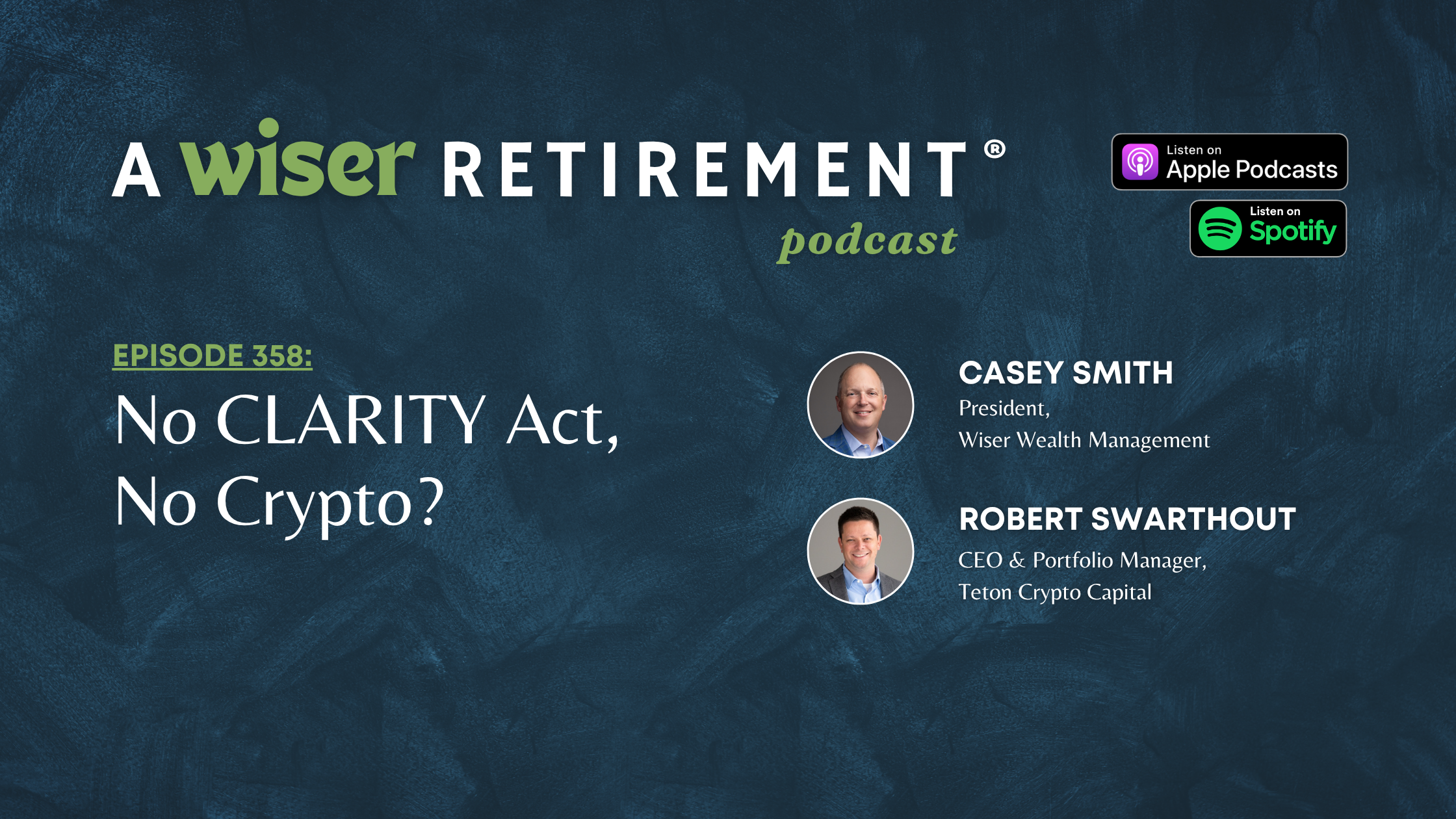
No CLARITY Act, No Crypto?
In this episode of A Wiser Retirement® Podcast, Casey Smith is joined by Robert Swarthout, founder and CEO of Teton Crypto Capital, to discuss what could happen if the CLARITY Act does not pass. They look at why the crypto industry wants clearer rules, how the SEC and CFTC could respond, why regulatory uncertainty may push development overseas, and how blockchain technology could extend far beyond buying and selling individual coins.
*The episode was recorded on August 25th, 2026, before the Senate action discussed in the conversation, so the timeline reflects what is known at the time of recording.*
Listen or Watch
Summary
The CLARITY Act Is About “Rules of the Road”
Robert pushes back on the idea that no CLARITY Act means no crypto. In his view, crypto continues developing either way. The bigger issue is whether more of that development happens inside or outside the United States.
The industry has spent years asking for clearer expectations. Entrepreneurs want to understand the compliance path before launching a project instead of believing they are operating legally and later receiving a Wells notice or enforcement action.
Banks, broker-dealers, and asset managers approach the issue differently, but they want the same thing. Before committing significant resources to crypto, they generally want legal clarity about what they can do.
That is why Robert describes the legislation as an attempt to establish the “rules of the road.”
Security or Commodity? That Distinction Matters
A major part of the CLARITY Act centers on determining whether a digital asset is a security or a commodity and which regulator has jurisdiction.
Robert notes that a crypto project can begin with significant control concentrated among its original team and then become more decentralized over time. The proposed framework attempts to recognize that evolution rather than treating every project the same indefinitely.
The legislation could also create more consistency across the country. Today, businesses can face different rules depending on the state in which they operate. A clearer federal framework would give companies a more uniform system instead of forcing them to navigate a patchwork of state requirements.
If Congress Does Not Act, Regulators Still Might
One important distinction in the episode is between legislation and agency rule-making.
Robert says the SEC and CFTC have indicated that they may be prepared to establish rules within their existing authority if Congress does not pass the CLARITY Act. That could provide the industry with some direction, but it does not offer the same permanence as legislation.
Agency rules can shift when administrations and regulatory leadership change. That leaves businesses wondering not only what the rules are today, but whether those rules could look very different several years from now.
If the CLARITY Act fails, Robert expects crypto to continue developing, but he believes more innovation could move to countries with clearer regulatory environments.
Crypto Is Bigger Than Buying Coins
Casey points out that many investors still think about crypto primarily in terms of buying a coin and hoping its price rises. Robert sees the larger story in the underlying technology and its potential utility.
One example is tokenization. Robert references the movement toward tokenized stocks and expanded trading hours as an indication of how blockchain infrastructure could change the way traditional assets trade.
Faster settlement is another potential use. Blockchain-based systems may allow transactions to settle much more quickly than current processes.
Stable coins also fit into that picture. Robert views their growth as an early example of moving value on blockchain networks and expects more financial activity to shift “on chain” as practical uses develop.
Decentralization and Regulation Are Not Necessarily Opposites
Crypto grows out of an idea of decentralization, which can make the industry’s push for government clarity seem contradictory.
Robert separates decentralized protocols from the centralized businesses built on top of them.
A blockchain can remain decentralized while a bank, asset manager, or other company uses that network to provide a service. The protocol itself does not necessarily need Washington’s permission to exist, but the business operating on top of it needs to know what laws and regulations apply.
That distinction helps explain why large financial institutions can embrace blockchain technology while still asking regulators for clearer boundaries.
Investors Still Need to Treat Crypto as High Risk
Clearer regulation does not remove the investment risks.
Robert is particularly cautious about the sheer number of cryptocurrencies in existence. He believes the overwhelming majority eventually go to zero, which makes choosing individual projects especially difficult for investors who are not following the industry closely.
For someone seeking crypto exposure without researching individual projects every day, he points to diversified ETF-style products as one possible way to spread that risk rather than concentrating it in a single lesser-known asset.
The episode also addresses volatility and manipulation. Crypto markets can move sharply, liquidity can change, and regulation does not make those risks disappear.
The Bigger Question Is Where Crypto Develops
The central takeaway is not that the CLARITY Act determines whether crypto lives or dies.
Robert expects the technology to keep moving forward. The more consequential question is whether the United States creates a regulatory framework that gives entrepreneurs and financial institutions enough certainty to build here.
If that happens, he believes blockchain could become increasingly integrated into the financial system through tokenization, settlement, stable coins, and other uses that are still developing.
For investors, that makes the regulatory debate relevant even if they never buy an individual cryptocurrency. The future of crypto may be shaped as much by how the technology is used inside financial infrastructure as by what happens to the price of any single coin.
Do you have specific questions regarding adding crypto to your financial portfolio? One of our financial advisors would be happy to chat with you during a complimentary consultation, either in our office in Marietta, or Virtually.
- Schedule a Complimentary Consultation: Discover how our services can help you achieve financial confidence.
- Access Our Free Guides: Gain valuable insights on topics such as why most financial plans fail, how to leave a financial legacy, post-divorce financial planning, and more!
- Subscribe to A Wiser Retirement® YouTube Channel.
- Listen to A Wiser Retirement® Podcast and access previous episodes.
Connect:

Recent posts


Share This Story, Choose Your Platform!
Wiser Wealth Management, Inc (“Wiser Wealth”) is a registered investment adviser with the U.S. Securities and Exchange Commission (SEC). As a registered investment adviser, Wiser Wealth and its employees are subject to various rules, filings, and requirements. You can visit the SEC’s website here to obtain further information on our firm or investment adviser’s registration.
Wiser Wealth’s website provides general information regarding our business along with access to additional investment related information, various financial calculators, and external / third party links. Material presented on this website is believed to be from reliable sources and is meant for informational purposes only. Wiser Wealth does not endorse or accept responsibility for the content of any third-party website and is not affiliated with any third-party website or social media page. Wiser Wealth does not expressly or implicitly adopt or endorse any of the expressions, opinions or content posted by third party websites or on social media pages. While Wiser Wealth uses reasonable efforts to obtain information from sources it believes to be reliable, we make no representation that the information or opinions contained in our publications are accurate, reliable, or complete.
To the extent that you utilize any financial calculators or links in our website, you acknowledge and understand that the information provided to you should not be construed as personal investment advice from Wiser Wealth or any of its investment professionals. Advice provided by Wiser Wealth is given only within the context of our contractual agreement with the client. Wiser Wealth does not offer legal, accounting or tax advice. Consult your own attorney, accountant, and other professionals for these services.