Can ChatGPT Manage Your Investments?
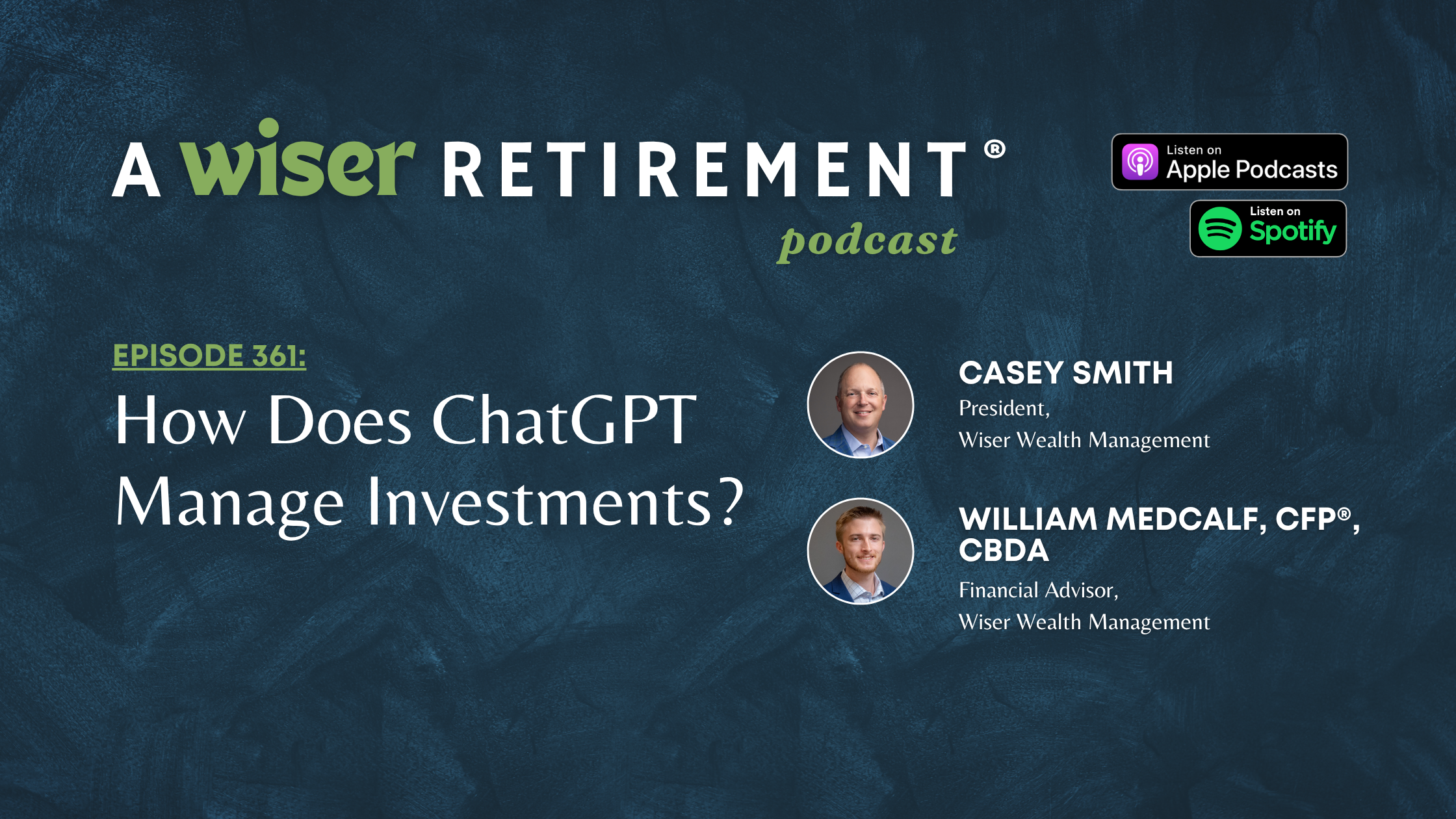
In this episode of A Wiser Retirement® Podcast, Casey Smith and Financial Advisor William Medcalf, CFP®, CBDA discuss how ChatGPT handles an investment question, what changes when it receives more details, and where its analysis still needs human judgment.
Watch or Listen
Summary
A Portfolio Recommendation Starts With a Withdrawal Question
William asks ChatGPT how to invest for a 55-year-old with a $2 million portfolio, moderate risk tolerance, plans to retire at 62, and a goal of spending $120,000 a year in retirement.
ChatGPT first flags the proposed spending: $120,000 is 6% of the $2 million portfolio. Rather than giving an allocation alone, it raises a question about withdrawals. It then suggests a mix with 50% in stocks, plus bonds, Treasury inflation-protected securities, and cash or Treasuries. Its answer also mentions low-cost index funds, a reserve for expected withdrawals, Social Security, and total return rather than a narrow focus on dividends.
Casey and William appreciate that the answer looks beyond fund selection. Still, they question whether the allocation is too conservative for someone seven years from retirement. They also notice that ChatGPT does not make its inflation assumptions clear. The recommendation gives them a starting point for discussion, but the percentages alone do not settle whether the plan fits the investor.
The Second Prompt Throws a Curveball
William then adds a $40,000 annual pension beginning at 65, a spouse earning $150,000 a year, a large holding in former employer stock, and a goal of leaving $1 million to the investor’s children. Casey likens the change to following an easy first pitch with a curveball.
ChatGPT recognizes that the employer stock creates concentration risk and suggests reducing the position over time. It also acknowledges that the pension and spouse’s income affect the need to draw from the portfolio. Yet its revised allocation becomes more conservative, which surprises both hosts. They question whether it has fully reworked the plan in light of the new information.
Other assumptions remain difficult to see. How long does the portfolio need to last? What inflation rate is the answer using? How does the goal of leaving money to the children affect spending and investment choices? ChatGPT can respond to the facts it receives, but a user may not know which questions still need to be asked.
Useful Analysis Is Different From Managing Investments
There are narrower questions ChatGPT may help answer. Casey and William suggest using it to examine fund overlap, sector exposure, expense ratios, or a concentrated stock position. Casey recalls an account holding several versions of a Russell 1000 fund, an example of something an investor might want to investigate. The tool can also help explain what ETFs hold or what terms such as diversification and rebalancing mean.
That kind of review differs from ongoing portfolio management. The hosts distinguish AI responses from automated trades that follow parameters set by a manager. They also discuss a possible future in which AI helps carry out portfolio tasks, while a person oversees the system and remains responsible for its use. For now, their ChatGPT exercise shows the gap between producing an allocation and managing investments within a full financial plan.
Privacy matters, too. Although portfolio statements could give a tool more to analyze, they can contain confidential information. Casey says Wiser does not put client information into general-purpose AI tools.
Look Past a Confident Answer, or an AI Label
A detailed answer is not necessarily an accurate one. Casey describes asking ChatGPT for help with a device for his car: it confidently points him to settings that are not there, then offers a different explanation when he challenges it. An investor who does not recognize a missing detail may have a harder time spotting a similar problem in financial analysis.
The hosts also caution listeners about investment offerings built around the appeal of “AI.” They describe cases in which AI language is used to promote promised returns, and call attention to “AI washing”: putting the label on a product without making clear how AI is actually used. The useful question is what the tool or strategy does, rather than how prominently it uses the term.
ChatGPT can help someone understand a portfolio and prepare more focused questions. The fictional investor’s two prompts show why its recommendation still needs scrutiny: a financial plan depends on income, withdrawals, goals, risks, and assumptions that may be missing from the conversation.
Do you have questions about your finances? Do you want a human to look at them? We offer a complimentary consultation with one of our fiduciary financial advisors, and would enjoy speaking with you!
- Schedule a Complimentary Consultation: Discover how our services can help you achieve financial confidence.
- Access Our Free Guides: Gain valuable insights on topics such as why most financial plans fail, how to leave a financial legacy, post-divorce financial planning, and more!
- Subscribe to A Wiser Retirement® YouTube Channel.
- Listen to A Wiser Retirement® Podcast and access previous episodes.
Connect:

Recent posts



Share This Story, Choose Your Platform!
Wiser Wealth Management, Inc (“Wiser Wealth”) is a registered investment adviser with the U.S. Securities and Exchange Commission (SEC). As a registered investment adviser, Wiser Wealth and its employees are subject to various rules, filings, and requirements. You can visit the SEC’s website here to obtain further information on our firm or investment adviser’s registration.
Wiser Wealth’s website provides general information regarding our business along with access to additional investment related information, various financial calculators, and external / third party links. Material presented on this website is believed to be from reliable sources and is meant for informational purposes only. Wiser Wealth does not endorse or accept responsibility for the content of any third-party website and is not affiliated with any third-party website or social media page. Wiser Wealth does not expressly or implicitly adopt or endorse any of the expressions, opinions or content posted by third party websites or on social media pages. While Wiser Wealth uses reasonable efforts to obtain information from sources it believes to be reliable, we make no representation that the information or opinions contained in our publications are accurate, reliable, or complete.
To the extent that you utilize any financial calculators or links in our website, you acknowledge and understand that the information provided to you should not be construed as personal investment advice from Wiser Wealth or any of its investment professionals. Advice provided by Wiser Wealth is given only within the context of our contractual agreement with the client. Wiser Wealth does not offer legal, accounting or tax advice. Consult your own attorney, accountant, and other professionals for these services.