
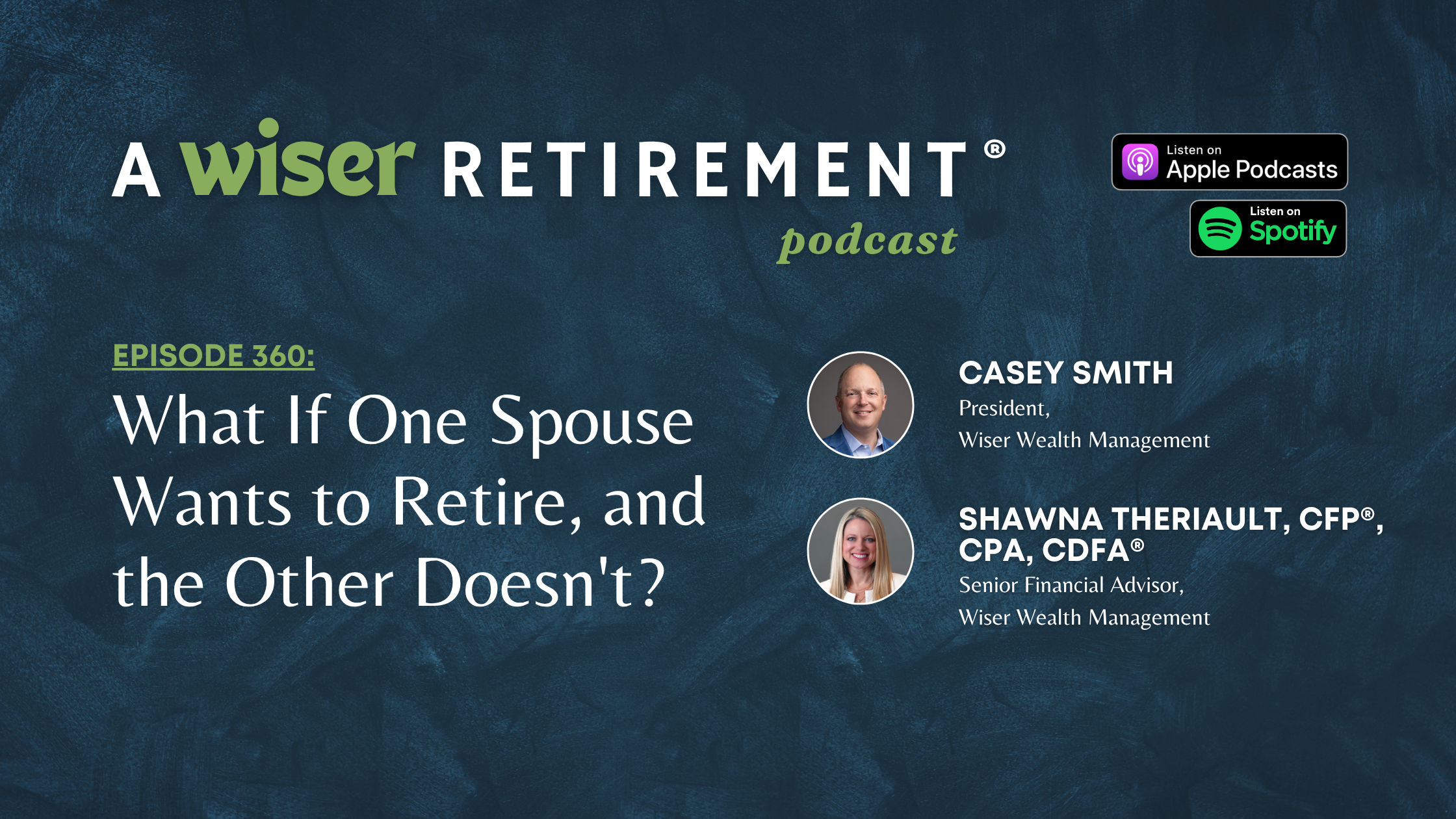
What If One Spouse Wants to Retire and the Other Doesn’t?
Retirement does not always happen on the same timeline for both spouses. One person may feel burned out and ready to leave a demanding career, while the other still enjoys working. That difference affects more than a retirement date, it can reshape household cash flow, healthcare coverage, taxes, Social Security decisions, and the way a couple imagines life together.
In this episode of A Wiser Retirement® Podcast, we discuss what happens when one spouse wants to retire while the other continues working. Casey Smith and Senior Financial Advisor Shawna Theriault, CFP®, CPA, CDFA®, explore both the financial calculations and personal conversations that help couples decide whether retiring at different times fits their shared plan.
Listen or Watch:
Summary
Why Couples Retire at Different Times
Spouses may reach retirement with different ages, careers, energy levels, and priorities. One person may be exhausted by frequent travel or changes within an industry. Another may still find purpose in a career and have no desire to leave it.
An age difference can also make staggered retirement more practical or even necessary. If one spouse is five, 10, or 15 years younger, continuing to work may provide income and benefits while the older spouse enters retirement.
The key is determining whether the working spouse remains employed by choice or because the financial plan depends on that income. Knowing that retirement is financially available can change how someone feels about work. A job may become more enjoyable when staying is a decision rather than an obligation.
Start With the Household Cash-Flow Gap
The first calculation is straightforward: If one paycheck disappears, can the remaining income cover the household’s expenses?
If not, the couple needs to determine where the difference comes from. They may need to begin portfolio withdrawals, reduce retirement-plan contributions from the working spouse’s paycheck, or reconsider certain expenses. Continuing to contribute automatically to a 401(k) while withdrawing from another retirement account may not always make sense, depending on taxes and cash flow.
The plan should also consider what happens if the working spouse stops sooner than expected. A strategy that works only when one person remains employed for five more years may need additional flexibility.
Healthcare Can Determine the Retirement Date
For someone retiring before age 65, healthcare is often one of the biggest planning questions. Can the retiring spouse join the working spouse’s employer plan? What will family coverage cost? Are children still covered under the plan?
Some people consider taking a lower-paying job primarily for health benefits, but that option needs to be based on an actual opportunity—not an assumption that a part-time job with coverage will be easy to find.
Medicare adds another layer when one spouse reaches eligibility while the other remains employed. Employer-plan rules and household income can affect coverage decisions and potential Medicare-related costs. These details should be reviewed before either spouse submits a retirement notice.
Social Security Estimates May Need a Closer Look
Retiring early does not automatically mean claiming Social Security early. Claiming before full retirement age can permanently reduce a benefit, including the amount available through a spouse’s earnings record.
Another consideration is how stopping work earlier than expected may affect the estimates shown on a Social Security statement. Those projections may assume continued earnings, so someone retiring in their 50s could ultimately receive a different amount.
For the higher earner, delaying benefits may also be considered because the surviving spouse generally keeps the higher of the couple’s two benefits. Health, longevity expectations, income needs, and the overall plan all influence the decision.
One Remaining Paycheck Can Change Tax Planning
When both spouses retire, the years before Social Security and required minimum distributions may create an opportunity to evaluate Roth conversions. If one spouse continues earning a substantial income, that lower-income window may not open immediately.
Social Security benefits, portfolio withdrawals, and Roth conversions can all add to taxable income. The working spouse’s earnings may also affect Medicare premiums for a spouse who is enrolled. That does not necessarily mean continuing to work is a poor financial choice; additional income can still strengthen the plan. It means the tax and healthcare effects need to be included in the calculation.
Retirement Requires More Than Financial Readiness
A couple can be financially prepared and still be personally unprepared for retirement. Someone leaving a fast-paced career may suddenly have far more unstructured time, particularly while a spouse continues following a normal work schedule.
Purpose does not need to generate income. It may come from family, volunteering, exercise, hobbies, community involvement, or a small job that provides social connection. Casey shares the example of a retiree who works one day a week in a chocolate shop, where she meets people and becomes part of the local community.
The question is not simply, “Can I retire?” It is also, “What am I retiring to?”
Age Gaps and Second Marriages Need Additional Planning
A significant age difference can create responsibilities that extend well beyond the older spouse’s lifetime. This is especially important in second marriages, families with young children, or households in which one spouse has earned and accumulated substantially more.
Life insurance, estate planning, and survivor income may need additional attention. The goal is to understand how the younger spouse and other family members would be affected if the older spouse dies first. Known risks can be addressed, but ignoring them may leave the surviving family with limited choices.
Make the Decision as a Couple
There is no universal answer to whether one spouse should retire first. The decision begins with the math: income, expenses, portfolio withdrawals, healthcare, taxes, Social Security, and the possibility that plans change.
It also requires an honest conversation about purpose, time, family, and shared expectations. One spouse continuing to work can strengthen the financial plan, but money is only part of the decision. The most useful retirement strategy brings together what the couple can afford, what each spouse wants, and what they want their life to look like.
If you have questions regarding you financial plan, please reach out to one of our financial advisors for a complimentary consultation today!
- Schedule a Complimentary Consultation: Discover how our services can help you achieve financial confidence.
- Access Our Free Guides: Gain valuable insights on topics such as why most financial plans fail, how to leave a financial legacy, post-divorce financial planning, and more!
- Subscribe to A Wiser Retirement® YouTube Channel.
- Listen to A Wiser Retirement® Podcast and access previous episodes.
Connect:

Recent posts



Share This Story, Choose Your Platform!
Wiser Wealth Management, Inc (“Wiser Wealth”) is a registered investment adviser with the U.S. Securities and Exchange Commission (SEC). As a registered investment adviser, Wiser Wealth and its employees are subject to various rules, filings, and requirements. You can visit the SEC’s website here to obtain further information on our firm or investment adviser’s registration.
Wiser Wealth’s website provides general information regarding our business along with access to additional investment related information, various financial calculators, and external / third party links. Material presented on this website is believed to be from reliable sources and is meant for informational purposes only. Wiser Wealth does not endorse or accept responsibility for the content of any third-party website and is not affiliated with any third-party website or social media page. Wiser Wealth does not expressly or implicitly adopt or endorse any of the expressions, opinions or content posted by third party websites or on social media pages. While Wiser Wealth uses reasonable efforts to obtain information from sources it believes to be reliable, we make no representation that the information or opinions contained in our publications are accurate, reliable, or complete.
To the extent that you utilize any financial calculators or links in our website, you acknowledge and understand that the information provided to you should not be construed as personal investment advice from Wiser Wealth or any of its investment professionals. Advice provided by Wiser Wealth is given only within the context of our contractual agreement with the client. Wiser Wealth does not offer legal, accounting or tax advice. Consult your own attorney, accountant, and other professionals for these services.