Yield Curve Inversions: What They Historically Signal for Recessions
What Is a Yield Curve?
Market forecasters use various economic data points and relationships to try and predict the general health of the overall economy. One economic relationship that is commonly studied is the slope of a government’s treasury yield curve.
To provide some context, a yield curve is a line graph that compares the relationship between interest rates or yields, located on the Y-axis, and maturity dates of bonds of the same credit quality on the X-axis.
What Does a Normal Yield Curve Look Like?
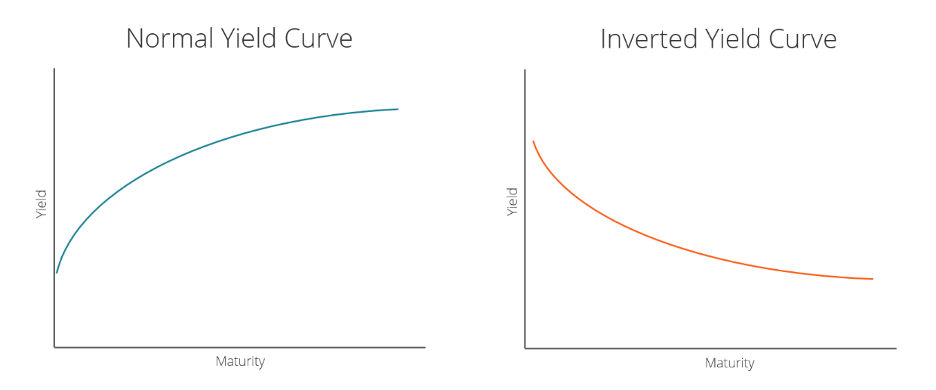
In normal market conditions the yield curve has a positive slope or is upward sloping, bottom left to upper right, as seen in the image below. The upward slope can be interpreted as reflecting a healthy economy where investors are comfortable taking risks. Interest rate risk is the key risk factor in government bonds, and this risk increases commensurately the longer a bond’s maturity. Therefore, a positive slope intuitively makes sense as a longer dated maturity bond should compensate investors with a higher return, or yield, due to it containing more interest rate risk relative to bonds with shorter dated maturities.
What Is an Inverted Yield Curve?
What if a yield curve slope does not have a “normal” shape? The other common yield curve shape is when it is inverted. An inverted yield curve can be explained as when short-term yields are higher than long-term yields. This relationship occurs when investors are more pessimistic about the economic prospects for the near future and that they are moving away from short-term bonds into long-term bonds; if there is more demand for longer-dated bonds then this increased buying would drive yields lower. Historically a yield curve becomes inverted in the lead-up to an economic slowdown or recession period.
https://corporatefinanceinstitute.com/resources/fixed-income/inverted-yield-curve/
Understanding Yield Curve Spreads
An easy way to analyze yield curve relationships is to look at a yield curve spread measure. A spread can be defined by the difference in interest rates between two different bond maturities. The two most common treasury yield curve spreads are the 10-Year minus 2-Year (“10Y-2Y”) Treasury yield, and the 10-Year minus 3-Month (“10Y-3M”) yield. Both measures can be used to assess broader market sentiment and to predict the likelihood of a potential recession. When both spreads are inverted, you could reasonably assume that the bond market is signaling that tight monetary policy is slowing economic growth and creating stress in capital markets, which in turn makes the economy more vulnerable for a contractionary growth period or a downturn
Yield Curve Inversions Before Recessions
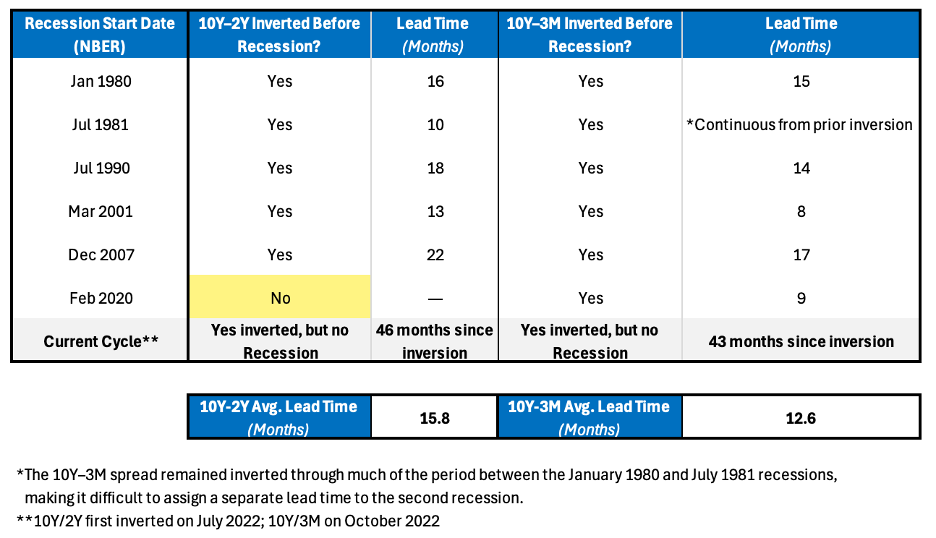
The table below shows the last six recession periods as defined by the National Bureau of Economic Research (“NBER”), and if either of the aforementioned spread measures inverted preceding a recession’s start period. In all periods, both spreads had inverted in months prior leading up to a recession except for one instance with 2020 recession where the 10Y-2Y spread did not invert beforehand.
By looking at this data set, we can reasonably assume that when there is a yield curve inversion, the probability of a recession greatly increases. When the 10Y-2Y spread inverts, the average lead time is about 16 months before a recession starts; 13 months for the 10Y-3M spread.
Why Yield Curve Inversions Are Not Infallible
An important caveat to this study, is that the conclusions above do not include the most recent spread inversion that had occurred for both measures. The 10Y-2Y spread inverted in July 2022, and several months later by the 10Y-3M spread inverted in October 2022. Since the most recent inversions, the U.S. has not experienced a recession, or one as defined by the NBER. Therefore, we should not treat this economic measure with infallibility when trying to forecast the next recession.
What Is the Yield Curve Telling Us Today?
Today September of 2026, the U.S. yield curve has course corrected from its 2022 inversion and now exhibits a relatively normal shape, with a positive slope and positive readings for both key yield curve spread measures. Based on this, we can reasonably conclude that the capital markets, or at least the bond market, are presently in a relatively healthy condition.
Reach out to schedule a complimentary consultation today, if you would like to learn more about how to create your financial plan.
Andrew Pratt, CFA, CBDA
Director of Investments, Wiser Wealth Management




Share This Story, Choose Your Platform!
Wiser Wealth Management, Inc (“Wiser Wealth”) is a registered investment adviser with the U.S. Securities and Exchange Commission (SEC). As a registered investment adviser, Wiser Wealth and its employees are subject to various rules, filings, and requirements. You can visit the SEC’s website here to obtain further information on our firm or investment adviser’s registration.
Wiser Wealth’s website provides general information regarding our business along with access to additional investment related information, various financial calculators, and external / third party links. Material presented on this website is believed to be from reliable sources and is meant for informational purposes only. Wiser Wealth does not endorse or accept responsibility for the content of any third-party website and is not affiliated with any third-party website or social media page. Wiser Wealth does not expressly or implicitly adopt or endorse any of the expressions, opinions or content posted by third party websites or on social media pages. While Wiser Wealth uses reasonable efforts to obtain information from sources it believes to be reliable, we make no representation that the information or opinions contained in our publications are accurate, reliable, or complete.
To the extent that you utilize any financial calculators or links in our website, you acknowledge and understand that the information provided to you should not be construed as personal investment advice from Wiser Wealth or any of its investment professionals. Advice provided by Wiser Wealth is given only within the context of our contractual agreement with the client. Wiser Wealth does not offer legal, accounting or tax advice. Consult your own attorney, accountant, and other professionals for these services.