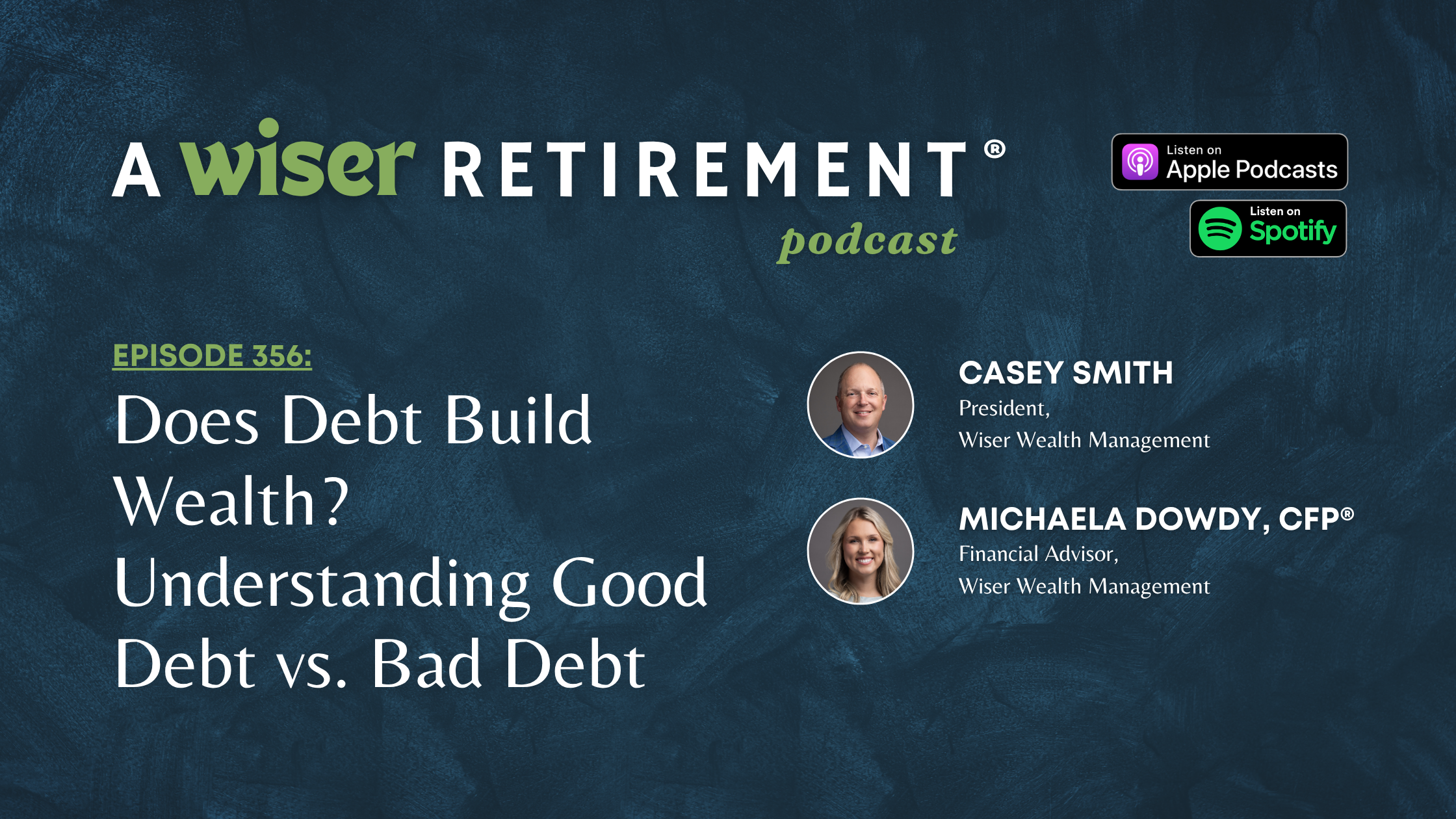
Does Debt Build Wealth? Understanding Good Debt vs. Bad Debt
In this episode of A Wiser Retirement® Podcast, Casey Smith and Financial Advisor Michaela Dowdy, CFP®, go over the difference between productive debt and expensive financial mistakes. They examine all variations of debt while asking, What are you actually getting in exchange for taking on the debt?
Listen or Watch
Summary
Being Debt-Free Is Not Always the Only Goal
For many households, reducing debt is a worthwhile objective, especially as retirement approaches. Casey points out that retirement planning is heavily dependent on cash flow. Entering retirement without a mortgage payment may provide considerably more flexibility than carrying the same payment into a period when employment income has stopped.
That does not mean every younger homeowner needs to rush to eliminate a low-rate mortgage. Someone earlier in their career may have other priorities competing for their dollars, from retirement contributions to building cash reserves.
The appropriate answer changes with age, income, interest rate, time horizon, and the rest of the financial plan.
Michaela also notes that attitudes toward debt are often behavioral. Someone who grows up watching a family struggle financially may become intensely focused on avoiding debt. Another person may become comfortable carrying significant balances because borrowing has always seemed normal.
That makes debt as much a behavioral issue as a mathematical one.
Five Questions Can Reveal Whether Debt Is Productive
Rather than automatically labeling a mortgage, student loan, or business loan as “good debt,” Casey suggests examining what the borrowing is actually accomplishing.
Consider:
- What does the debt purchase?
- Could the asset appreciate or generate income?
- What is the interest rate and total borrowing cost?
- Does the payment comfortably fit within cash flow?
- What happens if income falls or the asset loses value?
A mortgage illustrates why those questions matter. A house may appreciate over time, but that does not automatically make every mortgage prudent. Someone who spends so much on housing that there is little room for savings, maintenance, taxes, insurance, or an emergency may become “house poor.”
The same principle applies to rental property. Rental income can make leverage productive, but the owner still needs to make the mortgage payment when the property is vacant.
Your Primary Home Is Part Investment, Part Lifestyle
Casey challenges another common assumption: your home should not necessarily be viewed primarily as an investment.
A homeowner may build equity through principal payments and appreciation, but owning a home also comes with mortgage interest, property taxes, insurance, maintenance, renovations, transaction costs, and the opportunity cost of the original down payment.
That is why Casey views a primary residence largely as a lifestyle purchase. You buy it because you want to own your space, make it yours, and live there. Appreciation can contribute to your net worth, but that does not mean the house should become the focal point of your wealth-building strategy.
The equation changes when a former primary residence becomes a rental. At that point, the property begins generating income and is evaluated more like an investment.
A College Degree Does Not Automatically Make Student Loans “Good Debt”
Student loans receive particularly close scrutiny in the episode.
Casey argues that students should compare the cost of an education with the realistic earning potential associated with the degree. Borrowing a large amount for a career with relatively modest starting income creates a very different financial equation from borrowing for a field with substantially greater earning potential.
The school itself matters less than the economics of the decision.
That perspective also opens the door to alternatives such as lower-cost universities and trade schools. The goal is not simply to earn a particular credential. It is to consider the return on the money, and potentially years of debt that the education requires.
Business Debt Needs a Business Case
Borrowing becomes more complicated for business owners because leverage can be necessary to grow.
A company might finance equipment, technology, inventory, real estate, marketing, an acquisition, or additional employees. If borrowing $100,000 ultimately creates considerably more cash flow than the cost of servicing that loan, the debt may be productive.
But there is no guarantee.
Casey emphasizes the distinction between calculated business borrowing and speculation. Business owners may personally guarantee loans, meaning the consequences can extend well beyond the company if the investment does not work as planned.
The question is not simply, “Could this grow the business?” It is also, “What happens if it doesn’t?”
Credit Cards Become Dangerous When the Balance Becomes Normal
A Federal Reserve figure cited in the conversation indicates that 46% of credit card owners carried a balance at least once during 2024. Credit cards can provide convenience and rewards when the statement balance is paid in full, but carrying high-interest balances changes the equation considerably.
Michaela also warns against treating an available credit limit as an emergency fund. Having access to $20,000 on a credit card is not equivalent to having $20,000 in savings when borrowing that money could come with a substantial interest rate.
An actual cash reserve gives you more options when something unexpected happens.
Good Debt Can Turn Into Bad Debt
One of the most useful distinctions in the conversation is that debt does not receive a permanent label.
A loan that initially makes sense can become problematic if the payment begins preventing retirement savings, the borrower needs bonuses or investment gains to keep up with it, the interest rate increases, or the underlying asset loses value.
That is why debt needs to be evaluated within the entire financial plan rather than by the monthly payment alone.
Casey closes with five questions worth asking before borrowing: What am I buying? What is the total cost? How does it improve my financial position? Can I afford it if circumstances change? What am I giving up to make this payment?
Those questions provide a more useful framework than simply asking, “Can I afford the payment?” Debt can be a financial tool, but only when the economics, cash flow, and risk behind it make sense.
Do you have specific questions regarding your debt? One of our financial advisors would be happy to chat with you during a complimentary consultation, either in our office in Marietta, or Virtually.
- Schedule a Complimentary Consultation: Discover how our services can help you achieve financial confidence.
- Access Our Free Guides: Gain valuable insights on topics such as why most financial plans fail, how to leave a financial legacy, post-divorce financial planning, and more!
- Subscribe to A Wiser Retirement® YouTube Channel.
- Listen to A Wiser Retirement® Podcast and access previous episodes.
Connect:

Recent posts


Share This Story, Choose Your Platform!
Wiser Wealth Management, Inc (“Wiser Wealth”) is a registered investment adviser with the U.S. Securities and Exchange Commission (SEC). As a registered investment adviser, Wiser Wealth and its employees are subject to various rules, filings, and requirements. You can visit the SEC’s website here to obtain further information on our firm or investment adviser’s registration.
Wiser Wealth’s website provides general information regarding our business along with access to additional investment related information, various financial calculators, and external / third party links. Material presented on this website is believed to be from reliable sources and is meant for informational purposes only. Wiser Wealth does not endorse or accept responsibility for the content of any third-party website and is not affiliated with any third-party website or social media page. Wiser Wealth does not expressly or implicitly adopt or endorse any of the expressions, opinions or content posted by third party websites or on social media pages. While Wiser Wealth uses reasonable efforts to obtain information from sources it believes to be reliable, we make no representation that the information or opinions contained in our publications are accurate, reliable, or complete.
To the extent that you utilize any financial calculators or links in our website, you acknowledge and understand that the information provided to you should not be construed as personal investment advice from Wiser Wealth or any of its investment professionals. Advice provided by Wiser Wealth is given only within the context of our contractual agreement with the client. Wiser Wealth does not offer legal, accounting or tax advice. Consult your own attorney, accountant, and other professionals for these services.