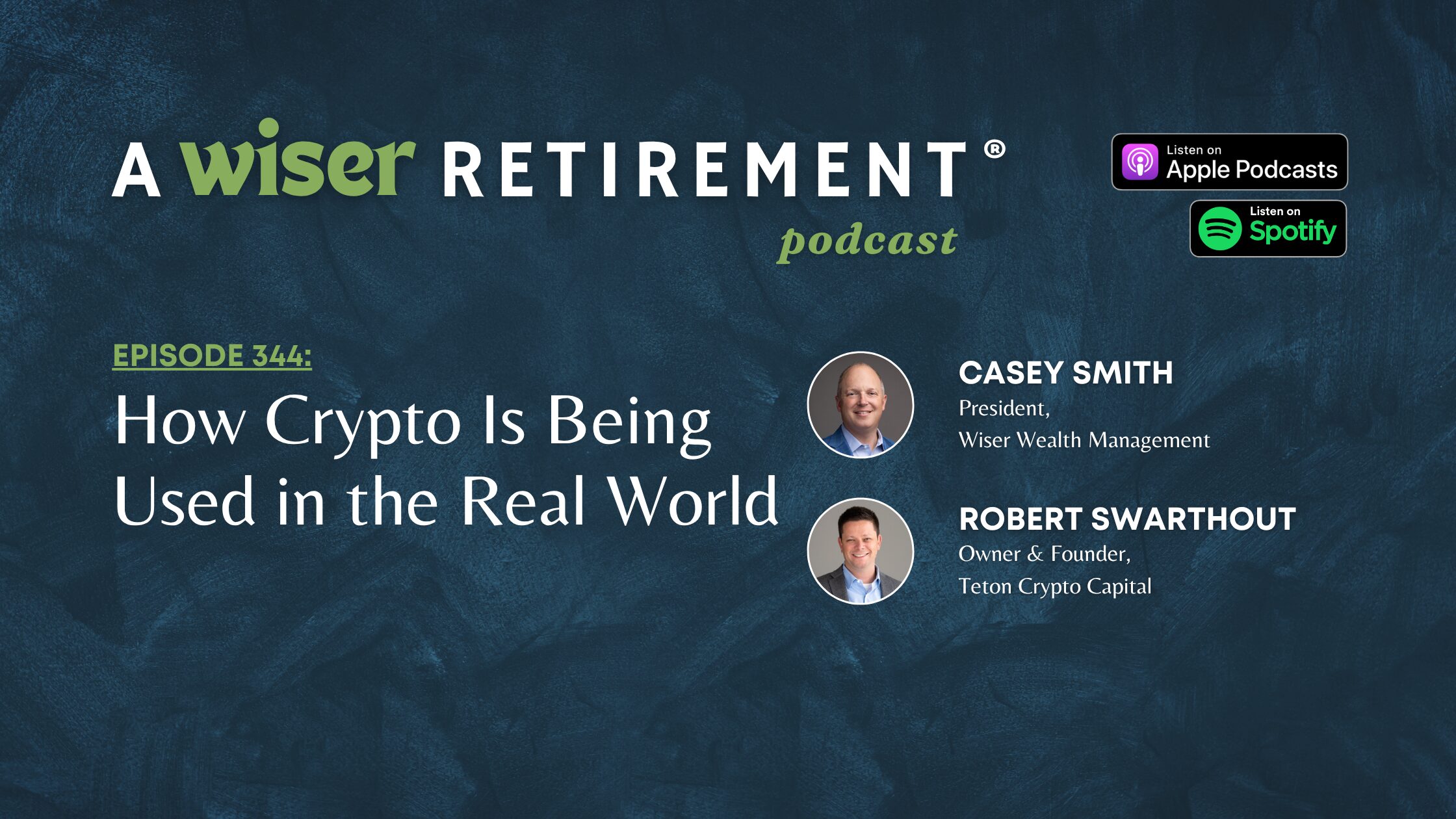
How Crypto Is Being Used in the Real World
In this episode of A Wiser Retirement® Podcast, Casey Smith speaks with Robert Swarthout, owner and founder of Teton Crypto Capital, about how blockchain technology, digital assets, and crypto-related companies are being used in real-world applications today.
Listen or Watch
Summary
Stablecoins and Digital Dollars
One of the most widely discussed crypto applications is the use of stablecoins. Circle, the company behind USDC, is one example. Unlike cryptocurrencies that fluctuate in price, stablecoins are designed to maintain a consistent value, often by being backed by cash equivalents and U.S. Treasuries.
Stablecoins may be useful for payments, but their broader application is in decentralized finance and settlement infrastructure. Rather than moving money back into a traditional bank account, users can hold funds in a stablecoin while staying within the blockchain ecosystem.
Visa is also testing stablecoin settlement, including using USDC to speed up payment rails. Traditional credit card transactions can take days to settle for merchants, while blockchain-based settlement may allow funds to move much faster.
Connecting Blockchain With Real-World Data
Chainlink is another important player in the crypto ecosystem. Chainlink Labs helps bring off-chain data onto blockchains through what are known as oracles. This matters because smart contracts often need outside information to execute properly.
For example, a smart contract may need confirmation that a service is completed, a payment condition is met, or an external event occurs. By connecting real-world data to blockchain networks, companies like Chainlink and Quant help bridge traditional systems and digital asset infrastructure.
Cross-Border Payments and Financial Infrastructure
Stellar and Ripple both focus on improving cross-border payments, though they serve different markets and use cases. Stellar often focuses on financial access and payment infrastructure in developing markets, while Ripple largely targets business and institutional payment needs.
Ripple, through XRP and its broader business ecosystem, also expands into custody, stablecoins, and institutional crypto services. The goal is to make international transfers and financial transactions faster and more efficient than some legacy systems.
Tokenization of Traditional Assets
Tokenization is one of the major themes shaping the future of crypto. Companies like Securitize help financial institutions create blockchain-based versions of funds, bonds, and other investment products. One example discussed in the episode is BlackRock’s BUIDL tokenized treasury fund.
Tokenized assets may eventually allow investments that traditionally trade only during market hours to be available on blockchain infrastructure around the clock. They may also improve settlement times, create more efficient record keeping, and increase access to certain types of assets.
Ondo Finance is another company working in this area, particularly around real-time markets and cross-border redemption. These developments suggest that parts of traditional finance continue to move toward blockchain-based systems.
Custody and Institutional Safeguards
As institutions become more involved in crypto, custody becomes a major issue. Fireblocks is one company helping institutions manage digital asset custody, transaction approvals, routing, and internal controls.
For businesses, funds, and financial institutions, digital asset custody requires more than simply holding a private key. It requires systems that define who can approve a transaction, how assets are accessed, and what happens if a key person is unavailable. This type of infrastructure is important for broader institutional adoption.
Decentralized Storage, Wireless Networks, and Computing Power
Not every crypto use case is directly tied to finance. Filecoin, for example, focuses on decentralized data storage. It works somewhat like a blockchain-based version of cloud storage, where files can be distributed across a decentralized network.
Helium focuses on creating a decentralized wireless network. Users can operate nodes that provide coverage for certain types of low-data devices, such as sensors or gauges.
Render Network focuses on decentralized computing power. The idea is to use idle graphics processing units, or GPUs, to help with rendering, creative production, and possibly AI-related computing needs. While the long-term viability of some of these models remains uncertain, they show how crypto can be used outside traditional financial markets.
Privacy, Advertising, and Digital Attention
Brave and the Basic Attention Token, known as BAT, offer another example of blockchain being applied outside finance. Brave is a privacy-focused browser, and BAT is designed to support a revenue-sharing model around digital advertising.
The idea is that users can receive a portion of advertising revenue in exchange for their attention. While the token may not be the main reason some users choose Brave, the model shows how crypto can be used to rethink online advertising and user privacy.
Smart Contracts and the Future of Automation
Smart contracts are one of the most compelling blockchain applications. These contracts are pieces of code that automatically execute when certain conditions are met.
In the podcast, Casey and Robert discuss how a smart contract might eventually be used in a construction scenario. For example, payments could be released when a third party verifies that a certain phase of a project is completed. This could apply to homebuilding, mortgage processes, vendor payments, and other contractual relationships.
While many of these examples are still developing, smart contracts may eventually reduce manual processes, create more transparency, and streamline certain business workflows.
Regulation Shapes the Next Phase of Crypto
Crypto regulation is another major topic of discussion. Stablecoin legislation helps create a framework for issuers of digital dollars, while broader market structure legislation, such as the Clarity Act, could help define the rules for digital assets more broadly.
The key issue is determining how various digital assets should be classified, whether as securities, commodities, or something else. Clearer regulation may give companies and innovators more confidence to build products in the space.
Crypto is still a young and highly speculative area, and not every company, token, or use case will endure. However, the industry is moving from purely theoretical conversations to real-world experimentation in payments, settlement, custody, tokenization, data storage, and smart contracts.
For investors and consumers, the key takeaway is that crypto may increasingly operate behind the scenes. Over time, people may use blockchain-powered systems without even realizing it. Rather than viewing crypto only as a speculative asset class, it may be more useful to understand how the underlying technology could reshape financial infrastructure and business processes.
As always, digital assets involve risk and should be evaluated carefully as part of a broader financial plan. For more information, please schedule a complimentary consultation today.
- Schedule a Complimentary Consultation: Discover how our services can help you achieve financial confidence.
- Access Our Free Guides: Gain valuable insights on topics such as why most financial plans fail, how to leave a financial legacy, post-divorce financial planning, and more!
- Subscribe to A Wiser Retirement® YouTube Channel.
- Listen to A Wiser Retirement® Podcast and access previous episodes.
Connect:

Recent posts



Share This Story, Choose Your Platform!
Wiser Wealth Management, Inc (“Wiser Wealth”) is a registered investment adviser with the U.S. Securities and Exchange Commission (SEC). As a registered investment adviser, Wiser Wealth and its employees are subject to various rules, filings, and requirements. You can visit the SEC’s website here to obtain further information on our firm or investment adviser’s registration.
Wiser Wealth’s website provides general information regarding our business along with access to additional investment related information, various financial calculators, and external / third party links. Material presented on this website is believed to be from reliable sources and is meant for informational purposes only. Wiser Wealth does not endorse or accept responsibility for the content of any third-party website and is not affiliated with any third-party website or social media page. Wiser Wealth does not expressly or implicitly adopt or endorse any of the expressions, opinions or content posted by third party websites or on social media pages. While Wiser Wealth uses reasonable efforts to obtain information from sources it believes to be reliable, we make no representation that the information or opinions contained in our publications are accurate, reliable, or complete.
To the extent that you utilize any financial calculators or links in our website, you acknowledge and understand that the information provided to you should not be construed as personal investment advice from Wiser Wealth or any of its investment professionals. Advice provided by Wiser Wealth is given only within the context of our contractual agreement with the client. Wiser Wealth does not offer legal, accounting or tax advice. Consult your own attorney, accountant, and other professionals for these services.