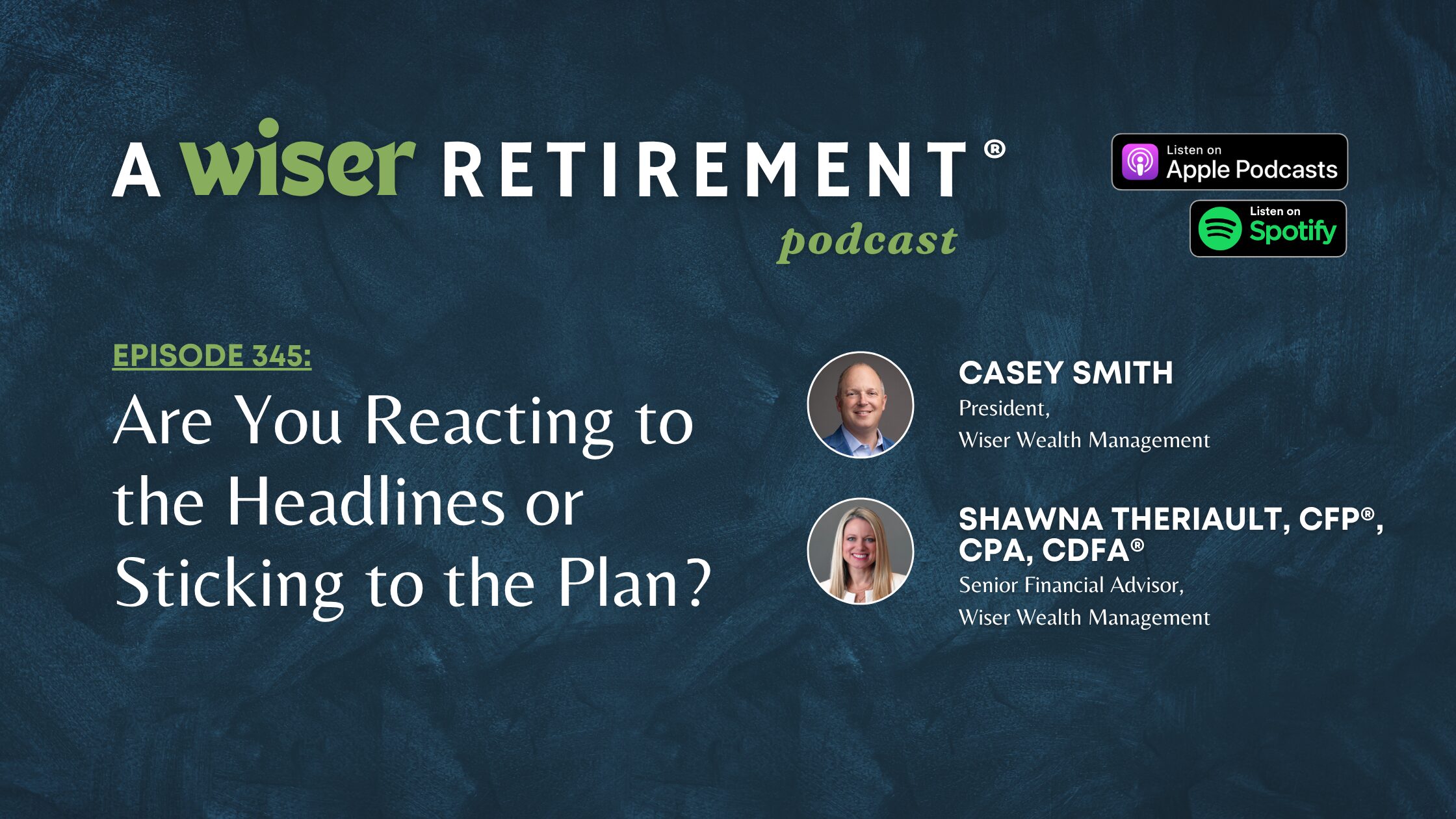
Are You Reacting to the Headlines or Sticking to the Plan?
Listen or Watch
Summary
For many investors, financial mistakes don’t begin with greed, they begin with fear. Headlines are designed to capture attention, not provide long-term perspective. Unfortunately, reacting emotionally to market news can have lasting consequences for your retirement and investment goals.
Why Financial Headlines Are Designed to Trigger Emotions
News organizations compete for attention. A headline that says, “Long-Term Investors Continue Building Wealth Through Market Volatility” isn’t likely to generate clicks. Fear, uncertainty, and urgency attract audiences.
The same principle applies to financial commentary. Whether it’s market predictions, political concerns, or economic forecasts, many voices in the media benefit from keeping investors engaged and emotional.
The challenge is that emotional investing often leads to poor decision-making.
The Hidden Cost of Emotional Investing
Investors are naturally susceptible to behavioral biases, including:
- Loss aversion
- Recency bias
- Action bias
- Fear of missing out
- The emotional comfort of “doing something”
When markets decline, taking action can feel productive. However, making changes simply to relieve anxiety can be damaging to long-term outcomes.
Sometimes the most strategic decision is staying disciplined and following the plan that was built before emotions entered the equation.
Lessons From Major Market Crises
Every market downturn feels unique while it’s happening. Yet history shows that markets have consistently recovered from periods that once seemed catastrophic.
The 2008 Financial Crisis
The 2008 financial crisis was one of the most severe market events in modern history. Banks were failing, unemployment was rising, and many investors feared the financial system itself might collapse.
Some investors sold near the bottom and permanently damaged their retirement prospects. Others stayed invested and participated in the recovery that followed.
The lesson wasn’t that downturns aren’t painful. The lesson was that abandoning a sound strategy during a crisis often creates more harm than the crisis itself.
COVID-19 in 2020
When markets dropped sharply during the pandemic, many investors feared the worst.
Yet investors who maintained adequate cash reserves and followed a structured plan were often able to remain calm. Some even viewed the downturn as an opportunity to rebalance portfolios and invest at lower prices.
The market recovered far faster than many expected, reinforcing the value of preparation over prediction.
Inflation and Rising Interest Rates in 2022
The inflation surge and rapid interest rate increases of 2022 created another difficult environment for investors.
Both stocks and bonds experienced pressure, leading many people to question whether traditional investing principles still worked.
However, disciplined investors who maintained diversified portfolios and focused on long-term goals benefited when markets rebounded in subsequent years.
Why Planning Matters More Than Predictions
No one consistently predicts market tops and bottoms.
Investors who attempt to move in and out of markets face two difficult decisions:
- When to get out.
- When to get back in.
Missing even a handful of strong market recovery days can significantly impact long-term returns.
Instead of relying on forecasts, successful investors often rely on planning.
A comprehensive financial plan accounts for market downturns before they happen. It incorporates cash reserves, diversified investments, tax strategies, withdrawal planning, and risk management to help investors stay on track through changing market conditions.
The Power of the Bucket Strategy
One approach that can help retirees remain disciplined is maintaining separate “buckets” for different financial needs.
A cash reserve can provide short-term spending needs, allowing retirees to avoid selling investments during market declines.
Bond holdings can provide additional stability and income.
Long-term growth assets, such as stocks, remain invested for future needs and inflation protection.
This structure can help investors focus less on daily market fluctuations and more on the long-term purpose of each asset.
Information vs. Emotion
Before making any major financial decision, ask yourself:
- Am I responding to facts or feelings?
- Does this decision align with my long-term goals?
- Am I seeking a better outcome or immediate reassurance?
The answers can reveal whether a decision is being driven by sound planning or emotional discomfort.
The Value of Having a Process
Markets will always experience uncertainty.
There will always be another recession prediction, geopolitical conflict, inflation concern, technological disruption, or market correction making headlines.
Investors cannot control headlines, but they can control their process.
A disciplined investment strategy, supported by comprehensive financial planning, helps investors avoid costly emotional decisions and remain focused on their long-term objectives.
The goal isn’t to eliminate fear. The goal is to have a plan strong enough that fear doesn’t dictate your financial future.
Do you have a plan if not, schedule a complimentary consultation today.
- Schedule a Complimentary Consultation: Discover how our services can help you achieve financial confidence.
- Access Our Free Guides: Gain valuable insights on topics such as why most financial plans fail, how to leave a financial legacy, post-divorce financial planning, and more!
- Subscribe to A Wiser Retirement® YouTube Channel.
- Listen to A Wiser Retirement® Podcast and access previous episodes.
Connect:

Recent posts



Share This Story, Choose Your Platform!
Wiser Wealth Management, Inc (“Wiser Wealth”) is a registered investment adviser with the U.S. Securities and Exchange Commission (SEC). As a registered investment adviser, Wiser Wealth and its employees are subject to various rules, filings, and requirements. You can visit the SEC’s website here to obtain further information on our firm or investment adviser’s registration.
Wiser Wealth’s website provides general information regarding our business along with access to additional investment related information, various financial calculators, and external / third party links. Material presented on this website is believed to be from reliable sources and is meant for informational purposes only. Wiser Wealth does not endorse or accept responsibility for the content of any third-party website and is not affiliated with any third-party website or social media page. Wiser Wealth does not expressly or implicitly adopt or endorse any of the expressions, opinions or content posted by third party websites or on social media pages. While Wiser Wealth uses reasonable efforts to obtain information from sources it believes to be reliable, we make no representation that the information or opinions contained in our publications are accurate, reliable, or complete.
To the extent that you utilize any financial calculators or links in our website, you acknowledge and understand that the information provided to you should not be construed as personal investment advice from Wiser Wealth or any of its investment professionals. Advice provided by Wiser Wealth is given only within the context of our contractual agreement with the client. Wiser Wealth does not offer legal, accounting or tax advice. Consult your own attorney, accountant, and other professionals for these services.