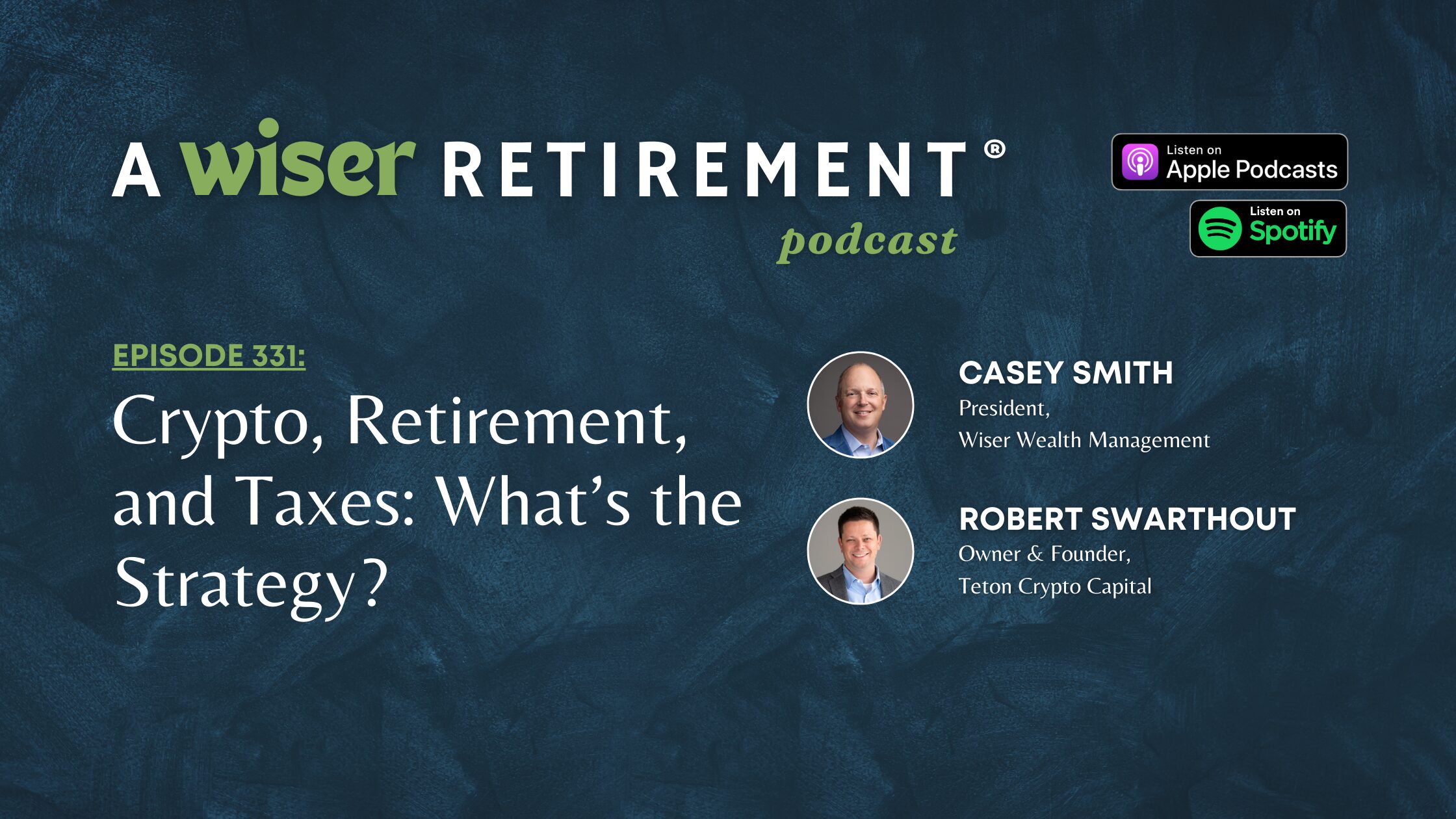
Crypto, Retirement, and Taxes: What’s the Strategy?
Listen or Watch
Summary
Accumulation vs. Retirement: A Shift in Purpose
During the accumulation phase, crypto often functions as a high-growth asset. Younger investors with longer time horizons may be more comfortable riding out the volatility.
In retirement, however, the role changes. Crypto doesn’t generate income like bonds or dividend-paying stocks. Instead, it serves as a growth sleeve within the broader portfolio. Rather than relying on it for withdrawals, retirees should think of crypto as part of their total allocation and rebalance it as needed.
Many professionals suggest keeping allocations modest, often in the 2–4% range. At that level, crypto can contribute to growth potential without overwhelming the portfolio’s overall risk profile.
Volatility Requires a Long-Term Mindset
Crypto’s volatility is in a category of its own. Daily moves that would be alarming in the stock market are relatively common in digital assets. That makes time horizon and emotional discipline critical.
If you’re nearing retirement and require a conservative allocation to fund lifestyle needs, crypto may not be appropriate. But for investors who can tolerate fluctuations and maintain a long-term outlook, a small allocation may enhance diversification.
The most important discipline is rebalancing. If crypto grows significantly beyond its target weight, trimming it back protects the portfolio. If it declines but still aligns with your strategy, rebalancing can restore the intended allocation.
Tax Planning Matters More Than You Think
Crypto is taxed similarly to stocks, with short-term and long-term capital gains. However, large gains can create ripple effects in retirement.
Capital gains increase taxable income, which can impact Social Security taxation and trigger IRMAA surcharges for Medicare premiums. Since IRMAA looks back two years, one high-income year from crypto gains could raise Medicare costs for multiple years.
For retirees, crypto decisions should never be made in isolation. They need to be coordinated with required minimum distributions (RMDs), pensions, Social Security timing, and broader tax planning strategies.
Custody and Estate Planning Considerations
One of crypto’s unique risks is custody. While ETFs have simplified ownership and reduced many security concerns, self-custodied assets introduce additional complexity. Lost passwords or poorly documented access can permanently lock assets away.
From an estate planning standpoint, crypto can be gifted or transferred much like other investments. But the practical challenge is ensuring heirs know where the assets are and how to access them. Coordination with a financial advisor, CPA, and estate attorney is essential to prevent assets from being unintentionally lost.
A Tool, Not a Replacement
Crypto doesn’t replace traditional retirement planning. It complements it when used thoughtfully.
When integrated properly, kept to a disciplined allocation, rebalanced consistently, and coordinated with tax and estate planning, crypto can serve as a strategic growth component. But without structure and planning, it can introduce unnecessary risk.
The difference comes down to whether it’s treated as a speculative bet or as part of a comprehensive financial strategy. Do you have questions about how crypto can fit into your financial plan? Schedule a complimentary consultation today!
- Schedule a Complimentary Consultation: Discover how our services can help you achieve financial confidence.
- Access Our Free Guides: Gain valuable insights on topics such as why most financial plans fail, how to leave a financial legacy, post-divorce financial planning, and more!
- Subscribe to A Wiser Retirement® YouTube Channel.
- Listen to A Wiser Retirement® Podcast and access previous episodes.
Connect:

Recent posts



Share This Story, Choose Your Platform!
Wiser Wealth Management, Inc (“Wiser Wealth”) is a registered investment adviser with the U.S. Securities and Exchange Commission (SEC). As a registered investment adviser, Wiser Wealth and its employees are subject to various rules, filings, and requirements. You can visit the SEC’s website here to obtain further information on our firm or investment adviser’s registration.
Wiser Wealth’s website provides general information regarding our business along with access to additional investment related information, various financial calculators, and external / third party links. Material presented on this website is believed to be from reliable sources and is meant for informational purposes only. Wiser Wealth does not endorse or accept responsibility for the content of any third-party website and is not affiliated with any third-party website or social media page. Wiser Wealth does not expressly or implicitly adopt or endorse any of the expressions, opinions or content posted by third party websites or on social media pages. While Wiser Wealth uses reasonable efforts to obtain information from sources it believes to be reliable, we make no representation that the information or opinions contained in our publications are accurate, reliable, or complete.
To the extent that you utilize any financial calculators or links in our website, you acknowledge and understand that the information provided to you should not be construed as personal investment advice from Wiser Wealth or any of its investment professionals. Advice provided by Wiser Wealth is given only within the context of our contractual agreement with the client. Wiser Wealth does not offer legal, accounting or tax advice. Consult your own attorney, accountant, and other professionals for these services.