Everything We Taught Our Kids About Choosing a College Major May Be Wrong in the Age of AI
The Traditional Advice May No Longer Apply
For most of the last twenty years, the answer seemed straightforward. If you wanted strong job prospects, good pay, and long-term career security, the advice was simple: major in computer science, engineering, data analytics, or another technology-focused field. These were the careers of the future. They offered a clear path to opportunity, and many parents encouraged their children to pursue them.
But artificial intelligence may be changing that equation faster than anyone expected.
The Majors Most Exposed to AI
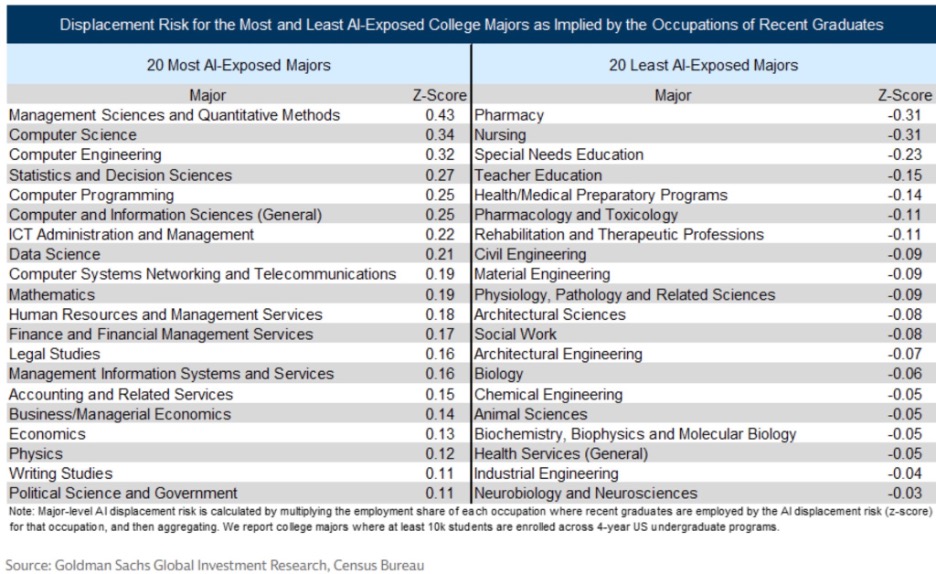
A recent Goldman Sachs analysis examined the occupations recent graduates typically enter and estimated the degree to which those jobs could be exposed to AI-driven displacement. The findings are surprising. Among the most AI-exposed majors were Management Sciences and Quantitative Methods, Computer Science, Computer Engineering, Statistics, Computer Programming, Data Science, Mathematics, Finance, Accounting, and Economics. In other words, many of the majors that have traditionally been viewed as the safest and most practical may now be among the most vulnerable to disruption.
At first glance, that sounds alarming. After all, weren’t these supposed to be the jobs that technology would create rather than replace? The reality is more nuanced. AI excels at processing information, analyzing data, generating reports, writing code, and performing many of the routine cognitive tasks that make up a large portion of entry-level knowledge work. The very skills that made these careers valuable are increasingly becoming the skills that AI can replicate.
AI Is Already Changing the Job Market
What makes this development especially significant is that AI isn’t just affecting future jobs, it is already reshaping today’s labor market. Major technology companies have openly discussed using AI to increase productivity and reduce the need for certain entry-level roles. Employers are beginning to expect young professionals to arrive with AI skills already integrated into their workflow. At the same time, some universities are reporting declines in computer science enrollment after years of explosive growth. Students are paying attention. They see headlines about AI writing code, generating marketing campaigns, analyzing financial data, and even assisting with legal research. Naturally, many are questioning whether the traditional path into technology offers the same level of security it once did.
The Majors Least Exposed to AI
What’s equally interesting is the list of majors that Goldman Sachs found to be least exposed to AI disruption. Pharmacy, nursing, special needs education, teacher education, rehabilitation professions, civil engineering, social work, biology, and neuroscience all ranked among the least vulnerable. These fields share an important characteristic: they require a significant human element. They depend on empathy, trust, judgment, physical presence, and real-world problem solving in environments that are difficult to automate.
AI may be able to assist a nurse, but it cannot hold a frightened patient’s hand before surgery. It can help a teacher create lesson plans, but it cannot build relationships with students or manage a classroom full of energetic children. It can optimize engineering calculations, but someone still has to inspect the bridge, evaluate conditions on the ground, and assume responsibility for the outcome. The closer a profession is to human interaction and physical reality, the harder it becomes to fully replace.
Why Technology Majors Still Matter
That doesn’t mean students should abandon technology majors. In fact, doing so could be a mistake. History shows that technological innovation rarely eliminates entire professions. Instead, it changes them. The spreadsheet didn’t eliminate accountants. The internet didn’t eliminate marketers. ATMs didn’t eliminate bankers. Likewise, AI probably won’t eliminate software engineers, financial analysts, lawyers, or financial advisors. Instead, it will likely transform how they work and reduce the amount of time spent on routine tasks.
The Career Ladder Problem
The bigger challenge may be what some economists call the “career ladder problem.” For decades, young professionals learned through repetitive entry-level work. Junior programmers wrote simple code. Junior analysts built spreadsheets. Junior accountants reconciled transactions. Those experiences served as training grounds that eventually produced senior professionals. If AI increasingly performs those tasks, how will the next generation gain the experience needed to become experts? That’s a question employers, universities, and students are only beginning to grapple with.
Exposure Does Not Equal Extinction
As a financial advisor, I find this particularly fascinating because it highlights an important distinction that often gets lost in conversations about AI. Exposure does not equal extinction. Some of the careers most exposed to AI may actually become more productive and more valuable because of it. A software engineer who knows how to leverage AI may accomplish the work of several developers. A physician using AI-assisted diagnostics may spend more time treating patients and less time reviewing charts. A financial advisor who automates research and administrative work can spend more time helping families navigate life’s biggest decisions. The winners may not be the people who avoid AI. The winners may be the people who learn how to work alongside it.
The Skills That Endure
Watching my daughter begin this next chapter, I keep coming back to a different conclusion. Perhaps we’ve spent too much time focusing on which major is safest and not enough time focusing on which skills endure regardless of technological change. The qualities that appear most resilient in an AI-driven world aren’t tied to any single major. They’re the ability to think critically, communicate clearly, solve complex problems, build relationships, lead others, adapt to change, and exercise sound judgment. Those skills matter whether you’re a nurse, engineer, teacher, entrepreneur, financial advisor, or equine science major.
And fortunately for my daughter and her two Irish Sport Horses, Henry and Mikey, who are also headed to the University of Kentucky equine science is probably not going extinct anytime soon.
Preparing for an Uncertain Future
As I sit here at orientation, I’m reminded that the future has always been uncertain. Every generation faces technological shifts that change the workforce in ways nobody fully anticipates. The students walking across campus today will almost certainly work in jobs that don’t yet exist, use technologies we can’t yet imagine, and solve problems that haven’t yet emerged. The goal isn’t to choose a major that is immune from change. The goal is to become the kind of person who can thrive despite it.
A Question for You
So I’ll leave you with a question:
If you were advising a college freshman sitting at orientation today, what major would you encourage them to pursue?
Casey Smith
President, Wiser Wealth Management




Share This Story, Choose Your Platform!
Wiser Wealth Management, Inc (“Wiser Wealth”) is a registered investment adviser with the U.S. Securities and Exchange Commission (SEC). As a registered investment adviser, Wiser Wealth and its employees are subject to various rules, filings, and requirements. You can visit the SEC’s website here to obtain further information on our firm or investment adviser’s registration.
Wiser Wealth’s website provides general information regarding our business along with access to additional investment related information, various financial calculators, and external / third party links. Material presented on this website is believed to be from reliable sources and is meant for informational purposes only. Wiser Wealth does not endorse or accept responsibility for the content of any third-party website and is not affiliated with any third-party website or social media page. Wiser Wealth does not expressly or implicitly adopt or endorse any of the expressions, opinions or content posted by third party websites or on social media pages. While Wiser Wealth uses reasonable efforts to obtain information from sources it believes to be reliable, we make no representation that the information or opinions contained in our publications are accurate, reliable, or complete.
To the extent that you utilize any financial calculators or links in our website, you acknowledge and understand that the information provided to you should not be construed as personal investment advice from Wiser Wealth or any of its investment professionals. Advice provided by Wiser Wealth is given only within the context of our contractual agreement with the client. Wiser Wealth does not offer legal, accounting or tax advice. Consult your own attorney, accountant, and other professionals for these services.