
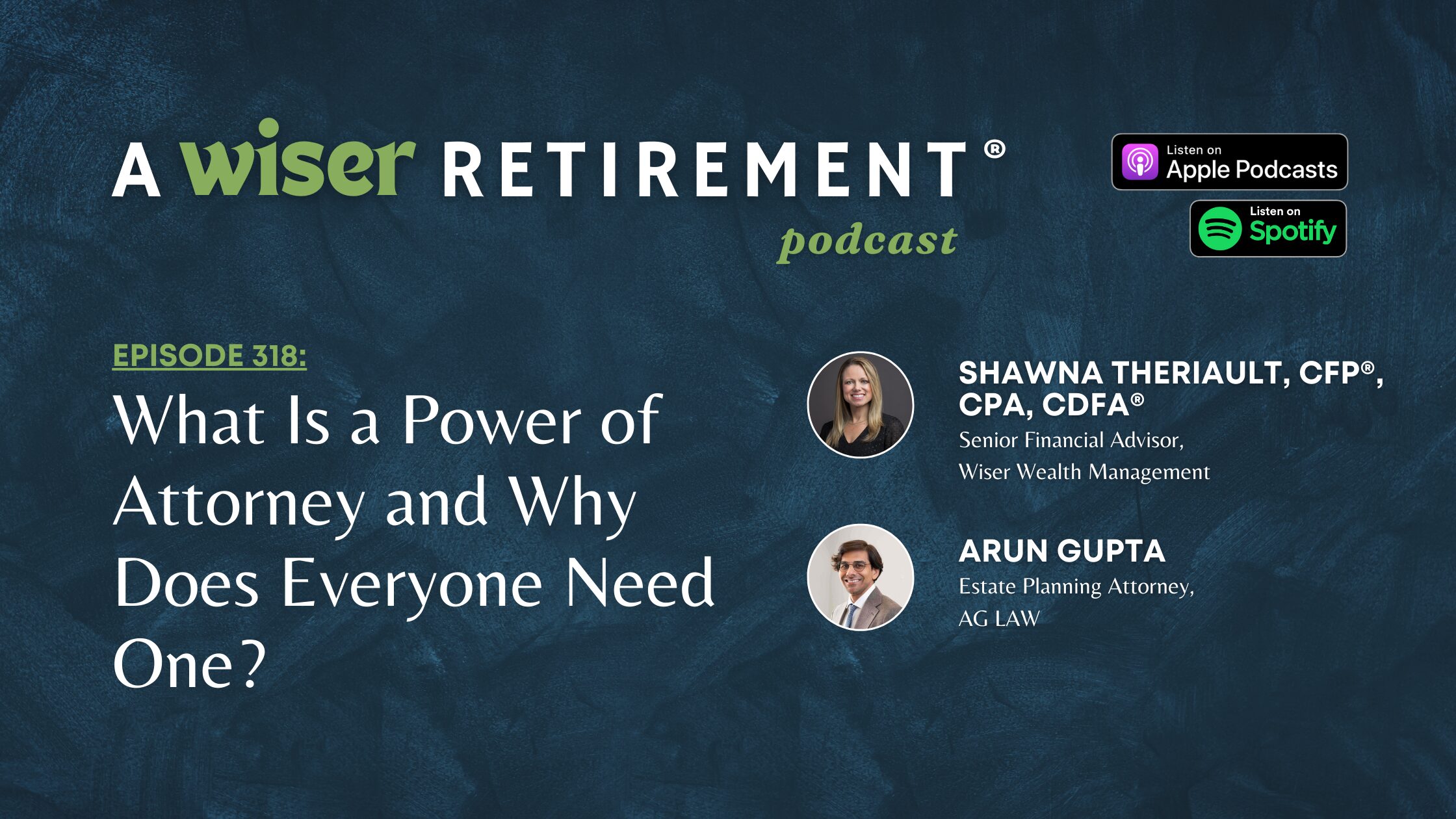
What Is a Power of Attorney and Why Does Everyone Need One?
If something unexpected happened tomorrow, who would make decisions for you? That’s the big question at the heart of this episode of the A Wiser Retirement® Podcast, where Shawna Theriault, CFP®, CPA, CDFA®, and Estate Planning Attorney Arun Gupta demystify what is a power of attorney and explain why nearly everyone needs them.
Listen or Watch:
Summary:
Why Powers of Attorney Matter More Than People Think
A surprising number of adults still don’t have essential estate planning documents in place. A 2023 LawDepot survey found that about 73% of respondents reported they did not have documents like wills, trusts, or powers of attorney. That gap is risky because estate planning isn’t only about what happens after death, it also protects you while you’re alive.
What a Power of Attorney Actually Is
A power of attorney (POA) is a legal document that lets you appoint an “agent” to act on your behalf. In other words, you’re choosing someone who can step into your shoes to handle important decisions if you can’t. POAs can be written to be broad or limited, temporary or long-term, depending on your needs.
The Two Main Types: Financial and Healthcare
Most people need two separate powers of attorney:
Financial Power of Attorney: Gives your agent the ability to manage finances, sign documents, pay bills, and handle transactions if you’re unavailable or incapacitated.
Healthcare Power of Attorney (Healthcare Directive): Allows your agent to make medical decisions if you cannot communicate your wishes. These documents typically include HIPAA waivers so your agent can access medical information and speak with doctors.
Together, they ensure both your money and medical care can be managed smoothly in a crisis.
Durable, General, and Limited POAs—What’s the Difference?
Not all POAs work the same way. The episode breaks down common categories:
Durable POA: The most common and often most useful. It remains valid even if you become incapacitated and stays in effect until you revoke it or pass away.
General POA: Often broad, but may end once you become incapacitated, depending on state law and how it’s drafted.
Limited POA: Only grants authority for specific tasks or a set period, such as handling a real estate closing while you’re traveling.
For most people, a durable financial POA is the foundation because it prevents decision-making gaps during emergencies.
Immediate vs. “Springing” Authority
A key decision is when your agent’s authority begins:
Effective immediately: Your agent can act as soon as the document is signed.
Springing: Your agent can only act after you’re officially deemed incapacitated, often requiring documentation from a doctor.
Springing POAs may feel safer, but the episode highlights real-life problems they can create, especially if someone refuses to see a doctor or is already experiencing cognitive decline. Planning ahead matters.
POAs Are State-Specific (And Financial Institutions Care)
POA forms and rules depend on your state. Some states, like Georgia, revised POA laws to standardize documents so banks and institutions can’t reject valid forms simply because they look unfamiliar. That consistency helps, but it also means you shouldn’t rely on a generic or out-of-state document without checking whether it complies locally.
Be Careful With “Special Powers”
Financial POAs often include an optional section for extra authority, like changing beneficiaries, modifying trusts, or making major gifts. These are powerful tools that can be abused, so the guidance is to avoid granting them unless there’s a specific reason and deep trust involved.
Choosing the Right Agent Without Creating Family Conflict
Picking an agent is about trust and capability, not fairness alone. Key guidance includes:
For financial POA, naming one responsible, financially savvy person is usually best unless co-agents truly align and won’t conflict.
For healthcare POA, co-agents can make more sense because decisions are emotional and family-based, and default rules often allow one to act if the other is unavailable.
Also, feelings matter. Open conversations now can prevent confusion and resentment later.
What If You Don’t Have a Spouse or Children?
This can be the toughest scenario, but having someone is still better than having no one. A trusted sibling, friend, niece/nephew, or another reliable adult can serve. Even if they feel overwhelmed, they can seek support from professionals, financial advisors, attorneys, and accountants, who already understand your plan.
How to Set Up a POA (And When to Update It)
You don’t technically need an attorney to create a POA, but professional help reduces the chance of errors and ensures coordination across your estate plan. The episode stresses revisiting POAs after major life events like marriage, divorce, health changes, or family shifts. Some states automatically revoke certain agents after marriage or divorce, while others don’t so updating matters.
Make Things Easier for the People Helping You
A practical takeaway: simplify your financial life. Consolidating accounts across fewer institutions makes it far easier for your agent to step in if needed. Otherwise, they may have to manage multiple banks, custodians, and scattered records during an already stressful time.
A power of attorney isn’t about losing control, it’s about maintaining control through preparation. By choosing trusted people, defining their authority clearly, and reviewing your documents over time, you protect yourself and the people who may need to help you later. Life is unpredictable, but your plan doesn’t have to be.
- Schedule a Complimentary Consultation: Discover how our services can help you achieve financial confidence.
- Access Our Free Guides: Gain valuable insights on topics such as why most financial plans fail, how to leave a financial legacy, post-divorce financial planning, and more!
- Subscribe to A Wiser Retirement® YouTube Channel.
- Listen to A Wiser Retirement® Podcast and access previous episodes.
Connect:

Recent posts



Share This Story, Choose Your Platform!
Wiser Wealth Management, Inc (“Wiser Wealth”) is a registered investment adviser with the U.S. Securities and Exchange Commission (SEC). As a registered investment adviser, Wiser Wealth and its employees are subject to various rules, filings, and requirements. You can visit the SEC’s website here to obtain further information on our firm or investment adviser’s registration.
Wiser Wealth’s website provides general information regarding our business along with access to additional investment related information, various financial calculators, and external / third party links. Material presented on this website is believed to be from reliable sources and is meant for informational purposes only. Wiser Wealth does not endorse or accept responsibility for the content of any third-party website and is not affiliated with any third-party website or social media page. Wiser Wealth does not expressly or implicitly adopt or endorse any of the expressions, opinions or content posted by third party websites or on social media pages. While Wiser Wealth uses reasonable efforts to obtain information from sources it believes to be reliable, we make no representation that the information or opinions contained in our publications are accurate, reliable, or complete.
To the extent that you utilize any financial calculators or links in our website, you acknowledge and understand that the information provided to you should not be construed as personal investment advice from Wiser Wealth or any of its investment professionals. Advice provided by Wiser Wealth is given only within the context of our contractual agreement with the client. Wiser Wealth does not offer legal, accounting or tax advice. Consult your own attorney, accountant, and other professionals for these services.