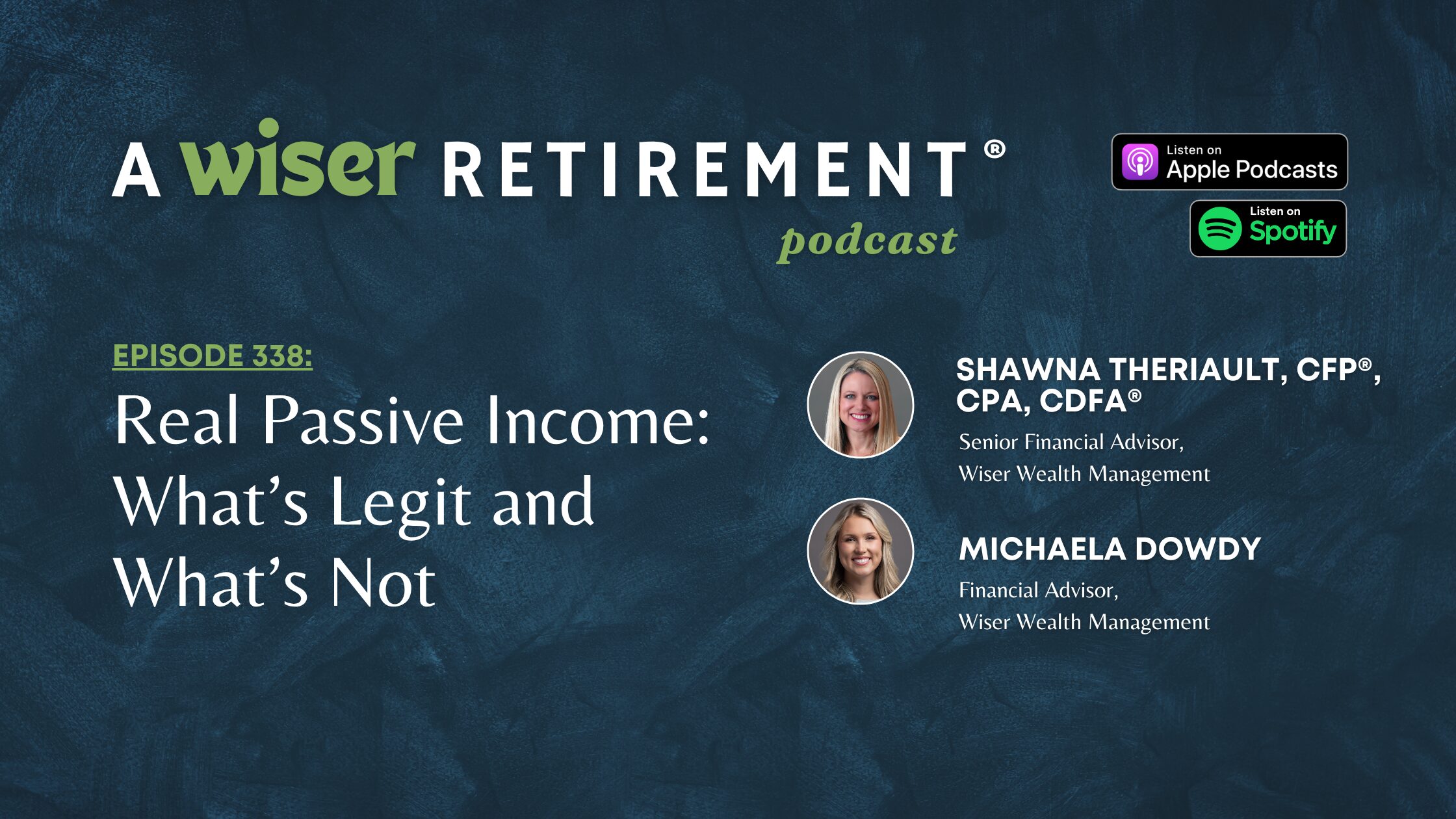
Real Passive Income: What’s Legit and What’s Not

Passive income is one of the most talked-about wealth-building strategies today, but it’s also one of the most misunderstood. From rental properties to online side hustles, many income streams labeled “passive” actually require far more time, effort, and involvement than people expect.

In this episode of the A Wiser Retirement® Podcast,  we take a closer look at the reality behind passive income, breaking down the myths, the misconceptions, and what it actually takes to build income that works for you.

Listen or Watch:

Summary:

What Does “Passive Income” Really Mean?

At its core, passive income is earnings that are not tied to ongoing, active labor. According to IRS guidelines, it typically includes income from rental activities or businesses where you do not materially participate. In simple terms, true passive income means your money is working for you, without your day-to-day involvement.

However, most so-called passive income streams fall into a gray area. They often require upfront work, ongoing management, or both, making them more “semi-passive” than truly hands-off.

Common Myths About Passive Income

Many popular income strategies are often mislabeled as passive. Here’s the reality:

  • Rental Properties: While they can generate income, they often require significant involvement, maintenance, tenant management, and unexpected repairs.
  • Side Hustles & Online Businesses: Selling on Etsy, Amazon storefronts, or creating digital products still requires setup, marketing, and upkeep.
  • Active Trading: Constantly buying and selling investments is the opposite of passive, it requires ongoing attention and decision-making.

The key takeaway? If your time and effort are required regularly, it’s not truly passive.

What Actually Counts as Passive Income?

True passive income is typically tied to ownership of assets, not active work. Some examples include:

  • Dividend-paying stocks and ETFs
  • Bonds and fixed-income investments
  • Real Estate Investment Trusts (REITs)
  • Business ownership with full operational management in place

In these cases, you’re not managing the asset, you’re simply benefiting from it.

The Trade-Offs No One Talks About

Building passive income isn’t without challenges. Some key trade-offs include:

  • Capital vs. Time: You either invest time upfront or significant capital to generate income.
  • Liquidity: Some passive investments tie up your money for long periods.
  • Risk vs. Return: Higher returns often come with higher risk or less accessibility.
  • Taxes: Passive income has unique tax rules, especially when it comes to losses.

Understanding these factors is crucial before committing to any strategy.

Why Passive Income Isn’t a Shortcut to Wealth

Despite what social media may suggest, there’s no quick path to building meaningful passive income. In fact:

  • Most households still rely primarily on earned income.
  • Truly passive income tends to be relatively small early on.
  • Wealth, and the passive income that comes with it, is built over time through discipline and consistency.

The reality is simple: passive income is a result of wealth-building, not a shortcut to it.

How to Build Passive Income the Right Way

Instead of chasing trends, focus on fundamentals:

  1. Start with a plan: Define your long-term goals.
  2. Build strong active income first: This funds your investments.
  3. Save and invest consistently: Small habits compound over time.
  4. Diversify your assets: Reduce risk and create multiple income streams.
  5. Stay disciplined: Avoid emotional decisions and “get rich quick” schemes.

Over time, these habits can help you transition from active income to more passive income streams.

Passive income is real, but it’s not as effortless or immediate as it’s often portrayed. Most strategies require some level of effort, especially early on. The most reliable path is long-term investing and asset ownership, built through consistent habits and smart planning.

If you want passive income, don’t start with a product, start with a plan. Do you have questions about how to build your wealth more efficiently? Schedule a complimentary consultation with us today!

Links:

Connect:

learn-more-2025-new

Recent posts

Share This Story, Choose Your Platform!

Wiser Wealth Management, Inc (“Wiser Wealth”) is a registered investment adviser with the U.S. Securities and Exchange Commission (SEC). As a registered investment adviser, Wiser Wealth and its employees are subject to various rules, filings, and requirements. You can visit the SEC’s website here to obtain further information on our firm or investment adviser’s registration.

Wiser Wealth’s website provides general information regarding our business along with access to additional investment related information, various financial calculators, and external / third party links. Material presented on this website is believed to be from reliable sources and is meant for informational purposes only. Wiser Wealth does not endorse or accept responsibility for the content of any third-party website and is not affiliated with any third-party website or social media page. Wiser Wealth does not expressly or implicitly adopt or endorse any of the expressions, opinions or content posted by third party websites or on social media pages. While Wiser Wealth uses reasonable efforts to obtain information from sources it believes to be reliable, we make no representation that the information or opinions contained in our publications are accurate, reliable, or complete.

To the extent that you utilize any financial calculators or links in our website, you acknowledge and understand that the information provided to you should not be construed as personal investment advice from Wiser Wealth or any of its investment professionals. Advice provided by Wiser Wealth is given only within the context of our contractual agreement with the client. Wiser Wealth does not offer legal, accounting or tax advice. Consult your own attorney, accountant, and other professionals for these services.